Skip to main content
Microeconomics
My Course
Learn
Exam Prep
AI Tutor
Study Guides
Flashcards
Explore
Try the app
My Course
Learn
Exam Prep
AI Tutor
Study Guides
Flashcards
Explore
Try the app
Back
Aggregate Demand definitions
You can tap to flip the card.
Aggregate Demand
You can tap to flip the card.
👆
Aggregate Demand
Total demand for all goods and services in an economy at various price levels, combining individual market demands into a single curve.
Track progress
Control buttons has been changed to "navigation" mode.
1/15
Related flashcards
Recommended videos
Aggregate Demand quiz
Aggregate Demand
15 Terms
02:47
Wealth Effect
1
views
03:43
Foreign Price Effect
1
views
05:48
Interest Rate Effect
1
views
Terms in this set (15)
Hide definitions
Aggregate Demand
Total demand for all goods and services in an economy at various price levels, combining individual market demands into a single curve.
Consumer Price Index
Measurement of overall price levels in an economy, used as the y-axis in aggregate demand analysis to track inflation.
Real GDP
Inflation-adjusted value of total production in an economy, serving as the x-axis in aggregate demand models.
Nominal GDP
Total value of goods and services produced in an economy, including current prices, not adjusted for inflation.
Wealth Effect
Reduction in consumer purchasing power due to rising prices, leading to decreased consumption and lower real GDP.
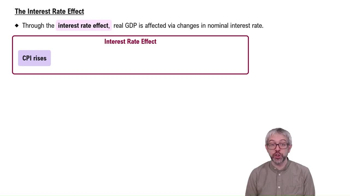
Interest Rate Effect
Increase in nominal interest rates from higher prices, causing reduced borrowing, investment, and consumption.
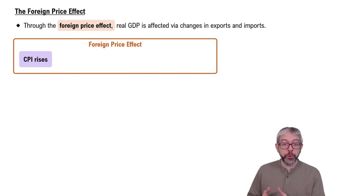
Foreign Price Effect
Impact of domestic price increases on exports and imports, resulting in lower net exports and decreased real GDP.
Purchasing Power
Ability of consumers to buy goods and services, which diminishes as price levels rise in the economy.
Net Exports
Difference between exports and imports in GDP calculation, affected by changes in domestic and foreign prices.
Inflation
General rise in price levels across an economy, commonly measured by the Consumer Price Index.
Deflation
Rare decrease in overall price levels, opposite of inflation, impacting aggregate demand dynamics.
Investment
Spending by businesses on capital goods, influenced by interest rates and borrowing costs.
Consumption
Expenditure by households on goods and services, a key component of real GDP affected by price changes.
Exports
Goods and services sold to foreign buyers, which decline when domestic prices rise relative to foreign prices.
Imports
Goods and services purchased from abroad, which increase when domestic prices rise compared to foreign prices.
 BackBack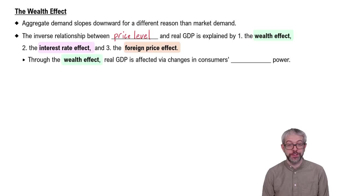
 02:47
02:47