Skip to main content
Microeconomics
My Course
Learn
Exam Prep
AI Tutor
Study Guides
Flashcards
Explore
Try the app
My Course
Learn
Exam Prep
AI Tutor
Study Guides
Flashcards
Explore
Try the app
Back
AD-AS Model: Shifts in Aggregate Demand definitions
You can tap to flip the card.
Aggregate Demand
You can tap to flip the card.
👆
Aggregate Demand
Total spending on goods and services from households, businesses, government, and net exports within an economy.
Track progress
Control buttons has been changed to "navigation" mode.
1/15
Related flashcards
Recommended videos
AD-AS Model: Shifts in Aggregate Demand quiz
AD-AS Model: Shifts in Aggregate Demand
15 Terms
Guided course
08:15
Equilibrium After a Decrease in Aggregate Demand
Guided course
06:03
Equilibrium After an Increase in Aggregate Demand
Terms in this set (15)
Hide definitions
Aggregate Demand
Total spending on goods and services from households, businesses, government, and net exports within an economy.
Short Run Equilibrium
Intersection of aggregate demand and short run aggregate supply, determining current price level and real GDP.
Long Run Equilibrium
Point where aggregate demand, short run aggregate supply, and long run aggregate supply meet, reflecting stable GDP.
Price Level
Average of current prices for all goods and services in an economy, used to track inflation or deflation.
Real GDP
Value of all goods and services produced, adjusted for inflation, indicating true economic output.
Short Run Aggregate Supply
Total production of goods and services available in the economy at different price levels for a limited period.
Long Run Aggregate Supply
Maximum sustainable output determined by factors of production, unaffected by price changes.
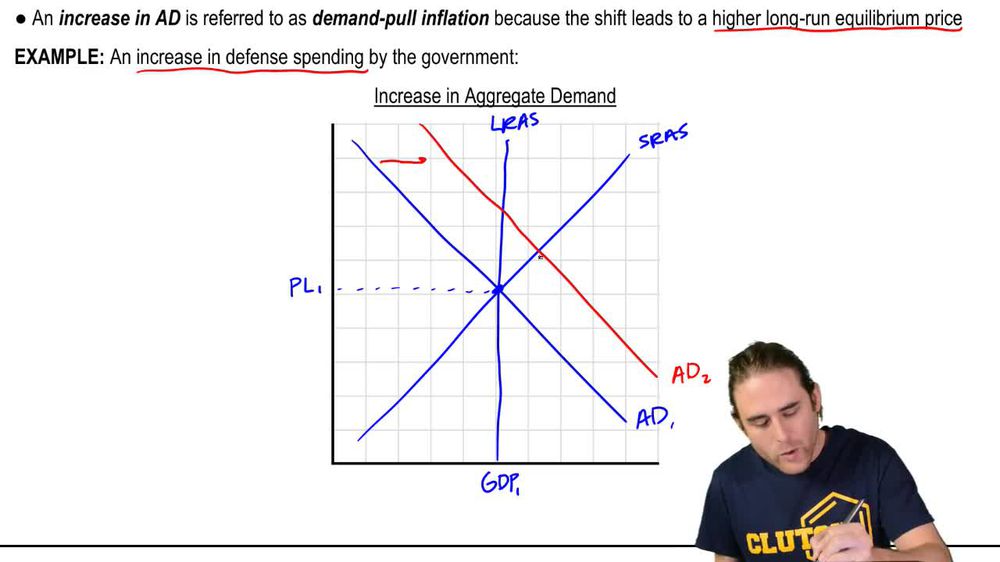
Demand-Pull Inflation
Rise in prices caused by increased aggregate demand, pushing price levels higher in the economy.
Cyclical Unemployment
Joblessness resulting from downturns in aggregate demand, often linked to recessions.
Investment Spending
Expenditures by businesses on capital goods, influencing aggregate demand and economic growth.
Government Purchases
Spending by the public sector on goods and services, directly impacting aggregate demand.
Net Exports
Difference between a country's exports and imports, contributing to aggregate demand.
Recession
Period of declining economic activity, marked by reduced aggregate demand and lower GDP.
Hot Economy
Situation where real GDP temporarily exceeds long run equilibrium, often due to overemployment and resource overuse.
Factors of Production
Inputs such as labor, capital, and land that determine the economy's long run output capacity.
 BackBack
 08:15
08:15