Skip to main content
Microeconomics
My Course
Learn
Exam Prep
AI Tutor
Study Guides
Flashcards
Explore
Try the app
My Course
Learn
Exam Prep
AI Tutor
Study Guides
Flashcards
Explore
Try the app
Back
AD-AS Model: Equilibrium in the Short Run and Long Run definitions
You can tap to flip the card.
Aggregate Demand
You can tap to flip the card.
👆
Aggregate Demand
Represents the total spending on goods and services at various price levels within an economy.
Track progress
Control buttons has been changed to "navigation" mode.
1/14
Related flashcards
Recommended videos
AD-AS Model: Equilibrium in the Short Run and Long Run quiz
AD-AS Model: Equilibrium in the Short Run and Long Run
15 Terms
Guided course
02:35
Short Run Equilibrium in the AD-AS Model
Guided course
02:28
Long Run Equilibrium in the AD-AS Model
Terms in this set (14)
Hide definitions
Aggregate Demand
Represents the total spending on goods and services at various price levels within an economy.
Short-Run Aggregate Supply
Shows the relationship between production and price level when some input prices are fixed.
Long-Run Aggregate Supply
Depicts the economy's maximum sustainable output when all prices are flexible.
Equilibrium Price Level
The point where the market's aggregate demand and aggregate supply curves intersect, setting overall prices.
Real GDP
Measures the value of all goods and services produced, adjusted for inflation, reflecting true economic output.
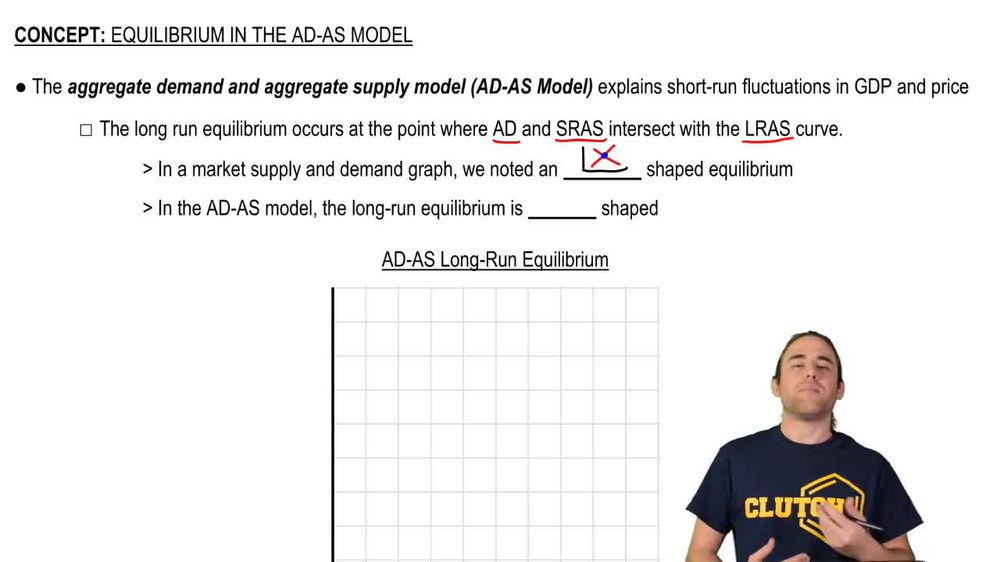
Long-Run Equilibrium
Occurs where aggregate demand, short-run aggregate supply, and long-run aggregate supply all meet.
Short-Run Equilibrium
The intersection of aggregate demand and short-run aggregate supply, determining temporary output and prices.
Economic Fluctuations
Variations in output and price level caused by shifts in aggregate demand or supply.
Market-Clearing Price
The price at which the quantity demanded equals the quantity supplied in the aggregate market.
Price Level
Represents the average of current prices across the entire spectrum of goods and services in the economy.
Output
The total amount of goods and services produced within an economy, often measured by real GDP.
Inflation
A sustained increase in the general price level, often resulting from shifts in aggregate demand or supply.
Graph
A visual representation used to illustrate the relationships between aggregate demand, supply, and equilibrium.
Intersection
The point where two or more curves meet, indicating equilibrium in the AD-AS model.
 BackBack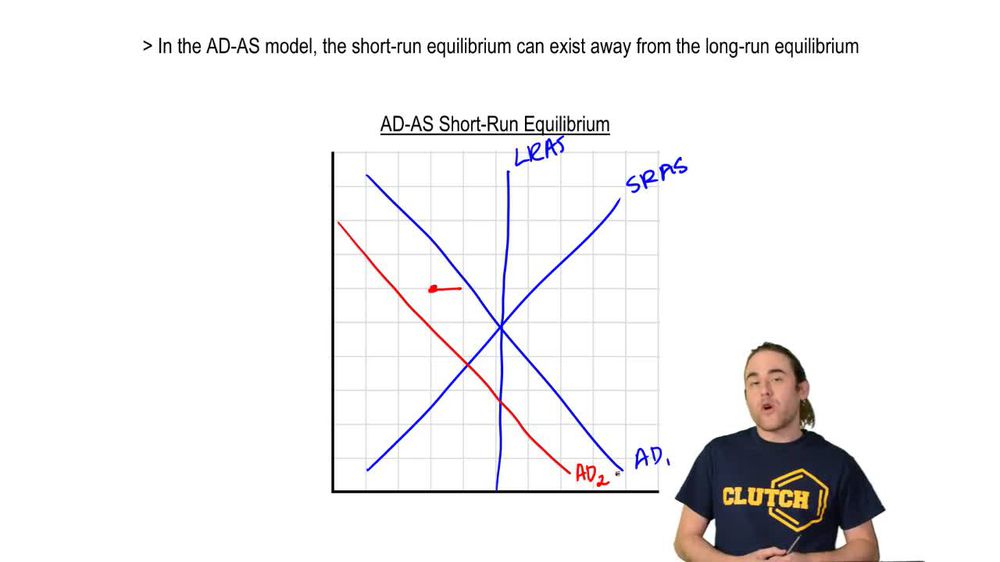
 02:35
02:35