Ch. 9 - Biotechnology & DNA Technology
Tortora - Microbiology: An Introduction 14th Edition
Tortora14th EditionMicrobiology: An IntroductionISBN: 9780138200398Not the one you use?Change textbook
Chapter 9, Problem 6

Describe an rDNA experiment in two or three sentences. Use the following terms: intron, exon, DNA, mRNA, cDNA, RNA polymerase, reverse transcriptase.

Verified step by step guidance
1
Begin by explaining that DNA contains both exons (coding regions) and introns (non-coding regions), and RNA polymerase transcribes DNA into pre-mRNA, which includes both exons and introns.
Next, describe how the pre-mRNA undergoes splicing to remove introns, resulting in mature mRNA that contains only exons.
Then, explain that reverse transcriptase is used to synthesize complementary DNA (cDNA) from the mature mRNA, which can be used in recombinant DNA (rDNA) experiments to study or manipulate specific gene sequences without introns.

Verified video answer for a similar problem:

This video solution was recommended by our tutors as helpful for the problem above.
Video duration:
1m
Was this helpful?

Key Concepts

Here are the essential concepts you must grasp in order to answer the question correctly.

Gene Structure: Introns and Exons

Genes are composed of exons, which code for proteins, and introns, non-coding sequences removed during mRNA processing. Understanding this distinction is crucial for interpreting how mRNA and cDNA represent only the exon sequences of a gene.
Recommended video:
Guided course
05:30
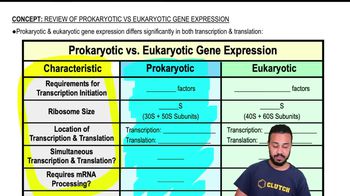
Review of Prokaryotic vs. Eukaryotic Gene Expression

Transcription and RNA Polymerase

RNA polymerase synthesizes mRNA from a DNA template by transcribing only the exons and introns present in the gene. This process produces a primary mRNA transcript that undergoes splicing to remove introns before translation.
Recommended video:
Guided course
05:03
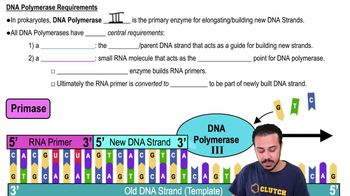
DNA Polymerases Requirements

Reverse Transcriptase and cDNA Synthesis

Reverse transcriptase is an enzyme that converts processed mRNA back into complementary DNA (cDNA), which lacks introns. This cDNA can be used in recombinant DNA experiments to clone genes without introns, facilitating gene expression studies.
Recommended video:
Guided course
04:28
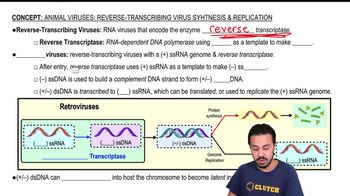
Animal Viruses: Reverse-Transcribing Virus Synthesis & Replication