Ch. 8 - Microbial Genetics
Tortora - Microbiology: An Introduction 14th Edition
Tortora14th EditionMicrobiology: An IntroductionISBN: 9780138200398Not the one you use?Change textbook
Chapter 8, Problem 8

You are provided with cultures with the following characteristics:
Culture 1: F+, genotype A+B+C+
Culture 2: F ̄, genotype A ̄B ̄C ̄
a. Indicate the possible genotypes of a recombinant cell resulting from the conjugation of cultures 1 and 2.
b. Indicate the possible genotypes of a recombinant cell resulting from conjugation of the two cultures after the F+ has become an Hfr cell.

Verified step by step guidance
1
Step 1: Understand the genotypes and mating types of the two cultures. Culture 1 is F^+ with genotype A^+B^+C^+, meaning it carries the fertility factor (F plasmid) and has wild-type alleles for genes A, B, and C. Culture 2 is F^-, with genotype ĀB̄C̄, meaning it lacks the F plasmid and has mutant alleles for these genes.
Step 2: For part (a), during conjugation between an F^+ donor and an F^- recipient, the F plasmid is transferred from the donor to the recipient. Since the F plasmid is separate from the bacterial chromosome, only the F plasmid genes (and possibly some plasmid genes) are transferred, not the chromosomal genes A, B, and C. Therefore, the recombinant F^- recipient will gain the F plasmid and become F^+, but its chromosomal genotype remains ĀB̄C̄.
Step 3: For part (b), when the F^+ plasmid integrates into the donor's chromosome, the cell becomes an Hfr (high frequency recombination) strain. During conjugation, the Hfr cell transfers part of its chromosomal DNA starting from the integrated F factor into the F^- recipient. This can result in recombinants with new combinations of alleles for genes A, B, and C depending on the order and extent of transfer.
Step 4: To determine possible recombinant genotypes after Hfr conjugation, consider the gene order and the direction of transfer. Since the donor is A^+B^+C^+, and the recipient is ĀB̄C̄, the recipient may receive one or more wild-type alleles (A^+, B^+, C^+) replacing the mutant alleles. Possible recombinants include partial combinations such as A^+B̄C̄, A^+B^+C̄, or A^+B^+C^+, depending on how far the transfer proceeds before conjugation is interrupted.
Step 5: Summarize that in (a), the recipient becomes F^+ but retains its original chromosomal genotype, while in (b), the recipient remains F^- but may acquire new chromosomal alleles from the Hfr donor, resulting in recombinant genotypes with mixed wild-type and mutant alleles.

Verified video answer for a similar problem:

This video solution was recommended by our tutors as helpful for the problem above.
Video duration:
2m
Was this helpful?

Key Concepts

Here are the essential concepts you must grasp in order to answer the question correctly.

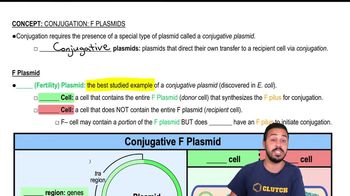
Bacterial Conjugation and F Plasmid

Bacterial conjugation is a process where genetic material is transferred from a donor (F⁺) to a recipient (F⁻) cell via direct contact. The F plasmid (fertility factor) enables the donor to form a pilus and transfer DNA. F⁺ cells carry the plasmid, while F⁻ cells lack it, influencing the transfer of genetic traits.
Recommended video:

Recombinant Genotypes from F⁺ × F⁻ Mating

When an F⁺ cell conjugates with an F⁻ cell, the F plasmid is transferred, converting the recipient into F⁺. However, only plasmid genes are typically transferred, so chromosomal genes (like A, B, C) usually remain unchanged in the recipient, resulting in recombinants with F plasmid traits but original chromosomal genotypes.
Recommended video:

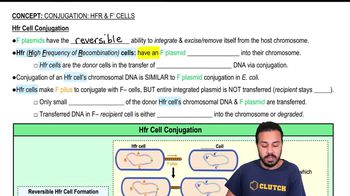
Hfr Cells and Chromosomal Gene Transfer

An Hfr cell has the F plasmid integrated into its chromosome, allowing transfer of chromosomal genes during conjugation. When an Hfr cell mates with an F⁻ cell, parts of the donor’s chromosome (e.g., A⁺, B⁺, C⁺) can be transferred and recombined into the recipient’s genome, producing recombinant genotypes with new chromosomal traits.
Recommended video:
Guided course
09:41
Hfr Cell Conjugation