
Ch. 8 - Microbial Genetics
Tortora - Microbiology: An Introduction 14th Edition
Tortora14th EditionMicrobiology: An IntroductionISBN: 9780138200398Not the one you use?Change textbook
Chapter 8, Problem 10

Which of the following is not a method of horizontal gene transfer?
a. Binary fission
b. Conjugation
c. Integration of a transposon
d. Transduction
e. Transformation

Verified step by step guidance
1
Step 1: Understand the concept of horizontal gene transfer (HGT). HGT is the movement of genetic material between organisms other than by the 'vertical' transmission from parent to offspring. It allows bacteria to acquire new genes from other bacteria or the environment.
Step 2: Review each option to determine if it represents a method of horizontal gene transfer. The common methods of HGT in bacteria are conjugation, transduction, and transformation.
Step 3: Analyze option (a) binary fission. Binary fission is a form of asexual reproduction where a single bacterial cell divides into two identical daughter cells. This process transmits genetic material vertically, not horizontally.
Step 4: Analyze option (b) conjugation. Conjugation involves direct transfer of DNA between two bacterial cells through a pilus, which is a classic example of horizontal gene transfer.
Step 5: Analyze options (c) integration of a transposon, (d) transduction, and (e) transformation. Integration of a transposon involves movement of DNA segments within or between genomes, transduction involves transfer of DNA by bacteriophages, and transformation involves uptake of free DNA from the environment—all are mechanisms of horizontal gene transfer.

Verified video answer for a similar problem:

This video solution was recommended by our tutors as helpful for the problem above.
Video duration:
2m
Was this helpful?

Key Concepts

Here are the essential concepts you must grasp in order to answer the question correctly.

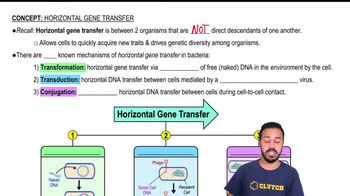
Horizontal Gene Transfer

Horizontal gene transfer (HGT) is the movement of genetic material between organisms other than by descent from parent to offspring. It allows bacteria to acquire new traits rapidly, such as antibiotic resistance, through mechanisms like conjugation, transformation, and transduction.
Recommended video:
Guided course
04:42
Horizontal Gene Transfer

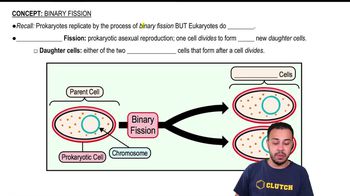
Binary Fission

Binary fission is an asexual reproduction process where a single bacterial cell divides into two identical daughter cells. It is a method of vertical gene transfer, passing genetic material from parent to offspring, not between different organisms.
Recommended video:
Guided course
02:16
Binary Fission

Mechanisms of Horizontal Gene Transfer: Conjugation, Transformation, Transduction, and Transposons

Conjugation involves direct transfer of DNA via cell-to-cell contact; transformation is uptake of free DNA from the environment; transduction uses bacteriophages to transfer DNA; and transposons are mobile genetic elements that can move within and between genomes, facilitating gene transfer.
Recommended video:
Guided course
04:42
Horizontal Gene Transfer