
Ch. 4 - Functional Anatomy of Prokaryotic and Eukaryotic Cells
Tortora - Microbiology: An Introduction 14th Edition
Tortora14th EditionMicrobiology: An IntroductionISBN: 9780138200398Not the one you use?Change textbook
Chapter 4, Problem 9

You have isolated a motile, gram-positive cell with no visible nucleus. You can assume this cell has
a. Ribosomes.
b. Mitochondria.
c. An endoplasmic reticulum.
d. A Golgi complex.
e. All of the above

Verified step by step guidance
1
Step 1: Identify the type of cell based on the given characteristics: motile, gram-positive, and no visible nucleus. These features suggest the cell is a prokaryote, specifically a bacterium, because prokaryotes lack a true nucleus and gram-positive refers to a bacterial staining characteristic.
Step 2: Recall the cellular structures present in prokaryotic cells. Prokaryotes have ribosomes, which are essential for protein synthesis, but they do not have membrane-bound organelles such as mitochondria, endoplasmic reticulum, or Golgi complex.
Step 3: Understand that mitochondria, endoplasmic reticulum, and Golgi complex are membrane-bound organelles found only in eukaryotic cells, not in prokaryotes like bacteria.
Step 4: Conclude that since the cell is gram-positive and lacks a nucleus, it must have ribosomes but not mitochondria, endoplasmic reticulum, or Golgi complex.
Step 5: Therefore, the correct assumption about this cell is that it has ribosomes (option a), but not the other organelles listed.

Verified video answer for a similar problem:

This video solution was recommended by our tutors as helpful for the problem above.
Video duration:
2m
Was this helpful?

Key Concepts

Here are the essential concepts you must grasp in order to answer the question correctly.

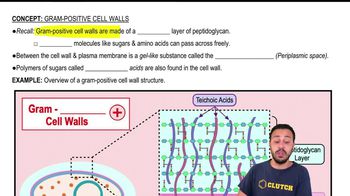
Gram-Positive Bacterial Cell Structure

Gram-positive bacteria have a thick peptidoglycan cell wall and lack a nucleus, classifying them as prokaryotes. Their cellular components differ from eukaryotes, notably lacking membrane-bound organelles such as mitochondria, endoplasmic reticulum, and Golgi complex.
Recommended video:
Guided course
02:59
Gram-Positive Cell Walls

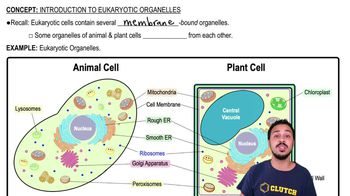
Prokaryotic vs. Eukaryotic Organelles

Prokaryotic cells, like bacteria, do not contain membrane-bound organelles such as mitochondria, endoplasmic reticulum, or Golgi apparatus. Instead, they have ribosomes for protein synthesis, which are smaller but functionally similar to those in eukaryotes.
Recommended video:
Guided course
03:45
Introduction to Eukaryotic Organelles

Ribosomes in Prokaryotes

Ribosomes are essential cellular structures responsible for protein synthesis and are present in all living cells, including prokaryotes. In bacteria, ribosomes are free-floating in the cytoplasm and are critical for translating genetic information into proteins.
Recommended video:
Guided course
01:51
Prokaryotic Ribosomes