Ch. 4 - Functional Anatomy of Prokaryotic and Eukaryotic Cells
Tortora - Microbiology: An Introduction 14th Edition
Tortora14th EditionMicrobiology: An IntroductionISBN: 9780138200398Not the one you use?Change textbook
Chapter 4, Problem 28.5a

Use the following choices to answer questions 3–5:
a. Bacillus coagulans
b. Byssochlamys
c. flat sour spoilage
d. Lactobacillus
e. thermophilic anaerobic spoilage


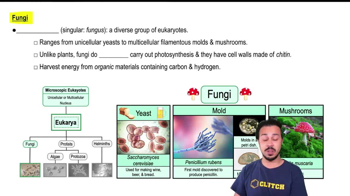
A heat-resistant fungus that causes spoilage in acidic foods.

Verified step by step guidance
1
Identify the key characteristics of the organism or spoilage type mentioned in the problem.
Recognize that the problem specifies a 'heat-resistant fungus' which is crucial for narrowing down the options.
Consider the environment in which the organism thrives, specifically 'acidic foods', which is another important clue.
Review the list of options provided and eliminate those that do not match the description of a 'heat-resistant fungus'.
Select the option that best fits the description of a heat-resistant fungus causing spoilage in acidic foods.

Verified video answer for a similar problem:

This video solution was recommended by our tutors as helpful for the problem above.
Video duration:
2m
Was this helpful?

Key Concepts

Here are the essential concepts you must grasp in order to answer the question correctly.

Heat-Resistant Fungi

Heat-resistant fungi are organisms that can survive high temperatures, often found in food processing environments. These fungi can withstand pasteurization and other heat treatments, making them a significant concern in food safety. Their ability to thrive in acidic conditions further complicates spoilage management, especially in products like canned or jarred foods.
Recommended video:

Acidic Foods

Acidic foods have a low pH, typically below 4.6, which can inhibit the growth of many spoilage organisms. However, certain fungi, such as Byssochlamys, are adapted to grow in these environments, leading to spoilage. Understanding the pH levels of food is crucial for predicting microbial growth and ensuring food safety.
Recommended video:

Spoilage Mechanisms

Spoilage mechanisms refer to the processes by which food deteriorates due to microbial activity, leading to changes in flavor, texture, and safety. In the context of fungi, spoilage can occur through the production of mycotoxins or off-flavors, particularly in heat-resistant species. Recognizing these mechanisms helps in developing effective preservation strategies.
Recommended video:
Guided course
01:59
Introduction to Avoiding Host Defense Mechanisms