Ch. 28 - Applied and Industrial Microbiology
Tortora - Microbiology: An Introduction 14th Edition
Tortora14th EditionMicrobiology: An IntroductionISBN: 9780138200398Not the one you use?Change textbook
Chapter 28, Problem 9

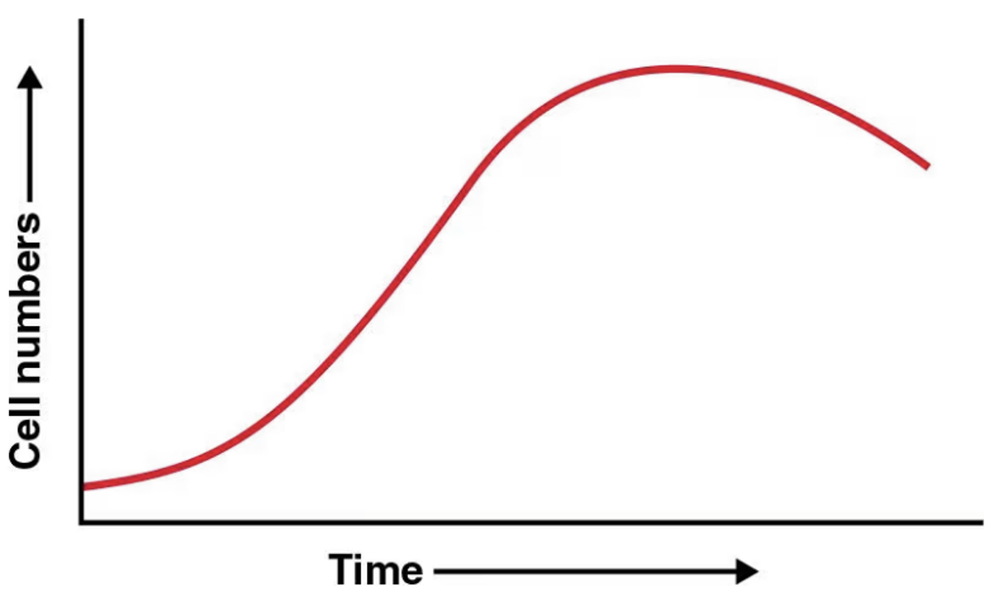
Label the trophophase and idiophase in this graph. Indicate when primary and secondary metabolites are formed.
Graph showing microbial growth curve with labeled trophophase, idiophase, and points of primary and secondary metabolite formation.

Verified step by step guidance
1
Step 1: Understand the growth phases of microorganisms depicted in the graph. The graph typically shows microbial growth over time, with the x-axis representing time and the y-axis representing biomass or cell concentration.
Step 2: Identify the trophophase on the graph. The trophophase is the active growth phase where cells are metabolically active and dividing rapidly. This phase usually corresponds to the exponential (log) phase of growth.
Step 3: Identify the idiophase on the graph. The idiophase follows the trophophase and is characterized by a slowdown or cessation of growth. During this phase, cells focus on producing secondary metabolites rather than biomass increase.
Step 4: Label the production of primary metabolites. Primary metabolites are compounds essential for growth and are produced during the trophophase. Examples include amino acids, nucleotides, and organic acids.
Step 5: Label the production of secondary metabolites. Secondary metabolites are not directly involved in growth but often have ecological functions such as antibiotics or pigments. These are produced during the idiophase.

Verified video answer for a similar problem:

This video solution was recommended by our tutors as helpful for the problem above.
Video duration:
6m
Was this helpful?

Key Concepts

Here are the essential concepts you must grasp in order to answer the question correctly.

Trophophase

Trophophase is the active growth phase of microorganisms where cells multiply rapidly and primary metabolites are produced. During this phase, nutrients are abundant, and metabolic activities focus on biomass accumulation and essential cellular functions.

Idiophase

Idiophase follows the trophophase and is characterized by slowed or halted growth. In this phase, secondary metabolites are synthesized, often as a response to nutrient limitation or stress, and these compounds can include antibiotics, pigments, or toxins.

Primary and Secondary Metabolites

Primary metabolites are compounds essential for growth and produced during trophophase, such as amino acids and nucleotides. Secondary metabolites are non-essential for growth, produced during idiophase, and often have ecological functions like defense or signaling.
Recommended video:
Guided course
02:33
Primary & Secondary Metabolites