Ch. 27 - Environmental Microbiology
Tortora - Microbiology: An Introduction 14th Edition
Tortora14th EditionMicrobiology: An IntroductionISBN: 9780138200398Not the one you use?Change textbook
Chapter 27, Problem 8

Use the following choices to answer the question:
a. Aerobic respiration
b. Anaerobic respiration
c. Anoxygenic photosynthesis
d. Oxygenic photosynthesis
Chemical equation showing carbon dioxide reduced to methane with protons and electrons producing water.

Verified step by step guidance
1
Step 1: Carefully examine the image provided in the problem to identify key features such as the presence or absence of oxygen production, types of pigments, electron donors, or any other metabolic indicators.
Step 2: Recall the definitions and characteristics of each metabolic process: (a) aerobic respiration uses oxygen as the final electron acceptor; (b) anaerobic respiration uses a molecule other than oxygen as the final electron acceptor; (c) anoxygenic photosynthesis does not produce oxygen and uses electron donors like H2S; (d) oxygenic photosynthesis produces oxygen and uses water as the electron donor.
Step 3: Match the observed features in the image to the characteristics of each process. For example, if oxygen production is indicated, it suggests oxygenic photosynthesis; if sulfur compounds are involved, it may indicate anoxygenic photosynthesis.
Step 4: Use the process of elimination by ruling out options that do not fit the observed data from the image, such as excluding aerobic respiration if no oxygen is involved or anaerobic respiration if photosynthesis is clearly depicted.
Step 5: Assign the correct letter choice (a, b, c, or d) to each question based on your analysis and understanding of the metabolic processes illustrated.

Verified video answer for a similar problem:

This video solution was recommended by our tutors as helpful for the problem above.
Video duration:
2m
Was this helpful?

Key Concepts

Here are the essential concepts you must grasp in order to answer the question correctly.

Aerobic and Anaerobic Respiration

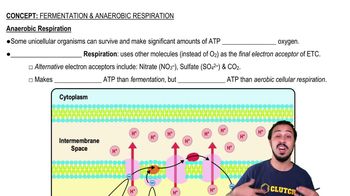
Aerobic respiration uses oxygen as the final electron acceptor to produce energy efficiently, while anaerobic respiration uses other molecules like nitrate or sulfate in the absence of oxygen. Both processes generate ATP but differ in energy yield and environmental conditions.
Recommended video:
Guided course
03:35
Anaerobic Respiration

Oxygenic and Anoxygenic Photosynthesis

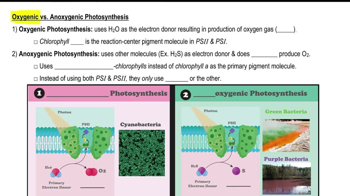
Oxygenic photosynthesis produces oxygen by splitting water molecules and is performed by plants, algae, and cyanobacteria. Anoxygenic photosynthesis does not produce oxygen and uses other electron donors like hydrogen sulfide, common in certain bacteria.
Recommended video:
Guided course
05:23
Oxygenic vs. Anoxygenic Photosynthesis

Electron Transport Chain and Energy Production

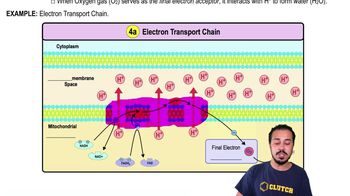
The electron transport chain (ETC) is a series of protein complexes that transfer electrons to generate a proton gradient, driving ATP synthesis. The type of electron acceptor (oxygen or other molecules) determines whether respiration is aerobic or anaerobic, affecting energy output.
Recommended video:
Guided course
07:41
Electron Transport Chain