The following processes are used in wastewater treatment. Match the stage of treatment with the processes. Each choice can be used once, more than once, or not at all.
Ch. 27 - Environmental Microbiology

Tortora14th EditionMicrobiology: An IntroductionISBN: 9780138200398Not the one you use?Change textbook
Chapter 27, Problem 9
Bioremediation refers to the use of living organisms to remove pollutants. Describe three examples of bioremediation.
Verified step by step guidance1
Understand that bioremediation is the process of using living organisms, such as bacteria, fungi, or plants, to degrade or remove environmental pollutants, making contaminated sites cleaner and safer.
Identify the first example: using bacteria to break down oil spills in marine environments. Certain bacteria can metabolize hydrocarbons found in oil, effectively reducing pollution in oceans.
Identify the second example: employing fungi to degrade complex organic pollutants like pesticides or industrial chemicals in soil. Fungi have enzymes capable of breaking down tough compounds that bacteria might not handle well.
Identify the third example: using plants in a process called phytoremediation, where plants absorb heavy metals or other toxins from contaminated soil or water, thereby cleaning the environment.
Summarize that these examples illustrate different types of organisms and mechanisms involved in bioremediation, highlighting its versatility in addressing various pollutants.

Verified video answer for a similar problem:
This video solution was recommended by our tutors as helpful for the problem above.
Was this helpful?
Key Concepts
Here are the essential concepts you must grasp in order to answer the question correctly.
Bioremediation
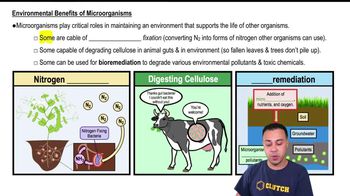
Bioremediation is the process of using living organisms, such as bacteria, fungi, or plants, to degrade or remove environmental pollutants. It is an eco-friendly and cost-effective method to clean contaminated soil, water, or air by transforming harmful substances into less toxic forms.
Recommended video:
Guided course
Environmental Benefits of Microorganisms
Microbial Degradation
Microbial degradation involves bacteria or fungi breaking down complex pollutants like oil spills or pesticides into simpler, non-toxic compounds. These microorganisms use pollutants as energy sources, facilitating natural cleanup processes in contaminated environments.
Recommended video:
Guided course
Introduction to Microbial Genetics
Phytoremediation
Phytoremediation uses plants to absorb, accumulate, or detoxify pollutants from soil or water. Certain plants can extract heavy metals or organic contaminants, making this method useful for restoring polluted sites while enhancing soil quality and preventing erosion.
Related Practice
Textbook Question
1
views
Textbook Question
Coliforms are used as indicator organisms of sewage pollution because
a. They are pathogens.
b. They ferment lactose.
c. They are abundant in human intestines.
d. They grow within 48 hours.
e. All of the above.
3
views
Textbook Question
These nitrogen-fixing prokaryotes provide nitrogen fertilizer in rice paddies; they live symbiotically in the cells of the freshwater plant Azolla.
6
views
Textbook Question
Use the following choices to answer the question:
a. Aerobic respiration
b. Anaerobic respiration
c. Anoxygenic photosynthesis
d. Oxygenic photosynthesis
3
views
Textbook Question
All of the following are effects of water pollution except
a. The spread of infectious diseases.
b. Increased eutrophication.
c. Increased BOD.
d. Increased growth of algae.
e. None of the above; all of these are effects of water pollution.
1
views