Ch. 24 - Microbial Diseases of the Respiratory System
Tortora - Microbiology: An Introduction 14th Edition
Tortora14th EditionMicrobiology: An IntroductionISBN: 9780138200398Not the one you use?Change textbook
Chapter 24, Problem 9

Match the following choices to the statement in the question given below:
a. Bordetella pertussis
b. Corynebacterium diphtheriae
c. Legionella pneumophila
d. Mycobacterium tuberculosis
e. None of the above
Causes the formation of a membrane across the throat.

Verified step by step guidance
1
Step 1: Understand the symptom described — the formation of a membrane across the throat is a hallmark clinical feature.
Step 2: Recall the diseases caused by each bacterium listed: Bordetella pertussis causes whooping cough; Corynebacterium diphtheriae causes diphtheria; Legionella pneumophila causes Legionnaires' disease; Mycobacterium tuberculosis causes tuberculosis.
Step 3: Identify which disease is characterized by a pseudomembrane forming in the throat, which can obstruct breathing.
Step 4: Match the bacterium responsible for that disease to the statement. The bacterium that causes diphtheria is known for producing a toxin that leads to membrane formation in the throat.
Step 5: Conclude that the correct match for the statement 'Causes the formation of a membrane across the throat' is the bacterium that causes diphtheria.

Verified video answer for a similar problem:

This video solution was recommended by our tutors as helpful for the problem above.
Video duration:
1m
Was this helpful?

Key Concepts

Here are the essential concepts you must grasp in order to answer the question correctly.

Corynebacterium diphtheriae and Diphtheria

Corynebacterium diphtheriae is the bacterium responsible for diphtheria, a disease characterized by the formation of a thick, gray membrane in the throat. This membrane can obstruct breathing and is caused by the bacterial toxin damaging epithelial cells and causing inflammation.

Bacterial Toxins and Pathogenesis

Certain bacteria produce exotoxins that damage host tissues and contribute to disease symptoms. In diphtheria, the diphtheria toxin inhibits protein synthesis in host cells, leading to cell death and membrane formation, which is a key factor in the disease's severity.
Recommended video:
Guided course
02:35
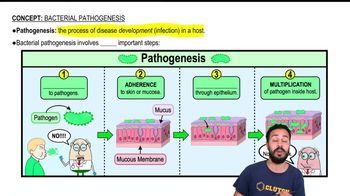
Intro to Bacterial Pathogenesis

Clinical Manifestations of Respiratory Bacterial Infections

Respiratory bacterial infections can present with distinct symptoms and signs, such as membrane formation, coughing, or pneumonia. Recognizing these clinical features helps in identifying the causative agent, as seen with the membrane in diphtheria caused by Corynebacterium diphtheriae.
Recommended video:
Guided course
03:27
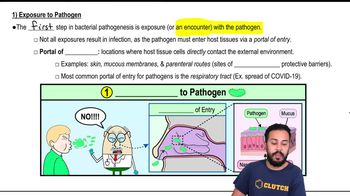
1) Exposure to Pathogen
Related Practice
Textbook Question

Match the following choices to the statement in the question given below:

a. Bordetella pertussis

b. Corynebacterium diphtheriae

c. Legionella pneumophila

d. Mycobacterium tuberculosis

e. None of the above

Resistant to destruction by phagocytes.

2
views
Textbook Question

Identify the bacteria involved in respiratory infections using the following laboratory test results:

Gram-positive cocci

Catalase-positive: a. ____________________________________

Catalase-negative

Beta-hemolytic, bacitracin inhibition: b. ____________________________________

Alpha-hemolytic, optochin inhibition: c. ____________________________________

Gram-positive rods

Non-acid-fast: d. ____________________________________

Acid-fast: e. ____________________________________

Gram-negative cocci: f. ____________________________________

Gram-negative rods

Aerobes

Coccobacilli: g. ____________________________________

Rods

Grow on nutrient agar: h. ____________________________________

Require special media: i. ____________________________________

Facultative anaerobes

Coccobacilli: j. ____________________________________

Intracellular parasites

Form elementary bodies: k. ____________________________________

Do not form elementary bodies: l. ____________________________________

Wall-less: m. ____________________________________

1
views
Textbook Question

In San Francisco, ten animal health care technicians developed pneumonia 2 weeks after 130 goats were moved to the animal shelter where they worked. Which of the following is false?

a. Diagnosis is made by a blood agar culture of sputum.

b. The cause is Coxiella burnetii.

c. The bacteria produce endospores.

d. The disease was transmitted by aerosols.

e. Diagnosis is made by complement-fixation tests for antibodies.

1
views
Textbook Question

These aerobic, gram-negative bacteria produce tracheal cytotoxin that kills ciliated cells of the trachea.

9
views
Textbook Question

Briefly describe the procedures and positive results of the tuberculin test and what is indicated by a positive test.

1
views
Textbook Question

Which of the following leads to all the rest?

a. Catarrhal stage

b. Cough

c. Loss of cilia

d. Mucus accumulation

e. Tracheal cytotoxin

1
views