Ch. 24 - Microbial Diseases of the Respiratory System
Tortora - Microbiology: An Introduction 14th Edition
Tortora14th EditionMicrobiology: An IntroductionISBN: 9780138200398Not the one you use?Change textbook
Chapter 24, Problem 10

Match the following choices to the statement in the question given below:
a. Bordetella pertussis
b. Corynebacterium diphtheriae
c. Legionella pneumophila
d. Mycobacterium tuberculosis
e. None of the above
Resistant to destruction by phagocytes.

Verified step by step guidance
1
Step 1: Understand the key characteristic in the question, which is 'resistant to destruction by phagocytes.' This means the bacterium can survive and multiply inside phagocytic cells, evading the host immune response.
Step 2: Review the properties of each bacterium listed: a) Bordetella pertussis, b) Corynebacterium diphtheriae, c) Legionella pneumophila, d) Mycobacterium tuberculosis, and e) none of the above.
Step 3: Recall that Mycobacterium tuberculosis is well-known for its ability to resist destruction by phagocytes due to its unique cell wall components like mycolic acid, which protect it from lysosomal enzymes.
Step 4: Compare the other bacteria: Bordetella pertussis causes whooping cough but is not primarily known for intracellular survival; Corynebacterium diphtheriae produces a toxin but does not survive inside phagocytes; Legionella pneumophila can survive inside macrophages but is less classically associated with this trait than M. tuberculosis.
Step 5: Based on this analysis, match the statement 'Resistant to destruction by phagocytes' to the bacterium that best fits this characteristic, which is Mycobacterium tuberculosis (d).

Verified video answer for a similar problem:

This video solution was recommended by our tutors as helpful for the problem above.
Video duration:
3m
Was this helpful?

Key Concepts

Here are the essential concepts you must grasp in order to answer the question correctly.

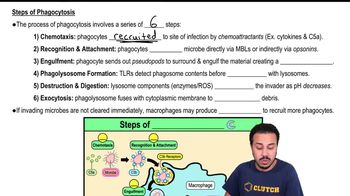
Phagocytosis and Microbial Evasion

Phagocytosis is a process where immune cells engulf and destroy pathogens. Some bacteria have evolved mechanisms to resist or survive phagocytic destruction, allowing them to persist and cause disease. Understanding these evasion strategies is key to identifying pathogens resistant to phagocytes.
Recommended video:
Guided course
08:57
Steps of Phagocytosis

Characteristics of Mycobacterium tuberculosis

Mycobacterium tuberculosis is known for its waxy, lipid-rich cell wall containing mycolic acids, which makes it resistant to phagocytic killing. It can survive inside macrophages by inhibiting phagosome-lysosome fusion, enabling it to evade the immune response and cause tuberculosis.
Recommended video:
Guided course
05:09
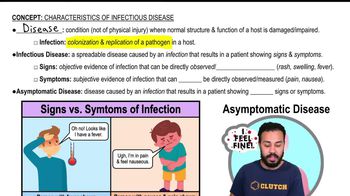
Intro to Characteristics of Infectious Disease

Differentiating Pathogenic Bacteria by Virulence Factors

Different bacteria possess unique virulence factors that determine their interaction with host defenses. For example, Bordetella pertussis produces toxins affecting respiratory cells, while Corynebacterium diphtheriae produces diphtheria toxin. Recognizing these factors helps match bacteria to their pathogenic traits, such as resistance to phagocytosis.
Recommended video:
Guided course
03:27
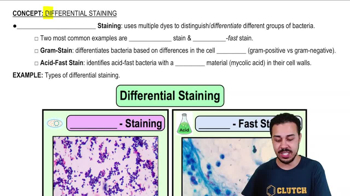
Differential Staining