Ch. 22 - Microbial Diseases of the Nervous System
Tortora - Microbiology: An Introduction 14th Edition
Tortora14th EditionMicrobiology: An IntroductionISBN: 9780138200398Not the one you use?Change textbook
Chapter 22, Problem 9

Provide evidence that Creutzfeldt-Jakob disease is caused by a transmissible agent.

Verified step by step guidance
1
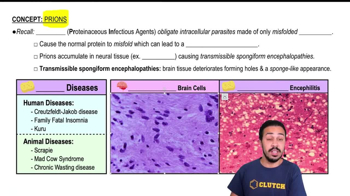
Understand that Creutzfeldt-Jakob disease (CJD) is a neurodegenerative disorder characterized by rapid dementia and spongiform changes in the brain, which suggests an infectious etiology despite the absence of conventional pathogens like bacteria or viruses.
Review historical experiments where brain tissue from CJD patients was inoculated into healthy animals (such as primates or rodents) and observe whether these animals developed similar neurological symptoms, indicating transmission of the disease.
Examine the resistance of the infectious agent to treatments that typically destroy nucleic acids (like UV radiation or nucleases), which supports the idea that the agent is a proteinaceous infectious particle (prion) rather than a conventional microorganism.
Analyze biochemical evidence showing the presence of an abnormal isoform of the prion protein (PrP^Sc) in infected brain tissue, which can induce misfolding of normal prion proteins (PrP^C) in recipient organisms, thus propagating the disease.
Consider epidemiological data demonstrating cases of CJD transmission through contaminated surgical instruments, corneal transplants, or growth hormone treatments, providing real-world evidence of a transmissible agent causing the disease.

Verified video answer for a similar problem:

This video solution was recommended by our tutors as helpful for the problem above.
Video duration:
2m
Was this helpful?

Key Concepts

Here are the essential concepts you must grasp in order to answer the question correctly.

Prion Theory

Creutzfeldt-Jakob disease (CJD) is caused by prions, which are misfolded proteins that induce abnormal folding of normal cellular proteins. Unlike viruses or bacteria, prions lack nucleic acids but are infectious and can transmit disease by converting normal proteins into the pathogenic form.
Recommended video:

Transmission Experiments

Evidence for transmissibility comes from experiments where brain tissue from CJD patients is inoculated into healthy animals, leading to disease development. This demonstrates that the agent causing CJD can be transmitted and cause infection, fulfilling Koch’s postulates for infectious agents.
Recommended video:
Guided course
08:56
The Griffith Experiment

Resistance to Conventional Sterilization

The infectious agent in CJD is resistant to standard sterilization methods that destroy bacteria and viruses, such as heat and radiation. This unusual resistance supports the idea that the agent is a prion, a proteinaceous infectious particle, rather than a conventional microorganism.
Recommended video:
Guided course
06:20
ABC Transporters Provide Multidrug Resistance