
Textbook Question
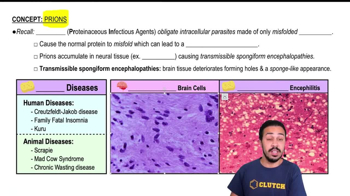
Identify the diseases based on the symptoms in the following chart.
1
views

 Verified step by step guidance
 03:05
03:05
 06:59
06:59 03:27
03:27Identify the diseases based on the symptoms in the following chart.
A patient has conjunctivitis. If you isolated Pseudomonas from the patient’s mascara, you would most likely conclude all of the following except that
a. The mascara was the source of the infection.
b. Pseudomonas is causing the infection.
c. Pseudomonas has been growing in the mascara.
d. The mascara was contaminated by the manufacturer.
e. All of the above are valid conclusions.
A 12-year old boy had a fever, rash, headache, sore throat, and cough. He also had a macular rash on his trunk, face, and arms. A throat culture was negative for Streptococcus pyogenes.
The boy most likely had
a. Streptococcal sore throat.
b. Measles.
c. Rubella.
d. Smallpox.
e. Hand-foot-mouth disease.
You microscopically examine scrapings from a case of Acanthamoeba keratitis. You expect to see
a. Nothing.
b. Viruses.
c. Gram-positive cocci.
d. Eukaryotic cells.
e. Gram-negative cocci.
Complete the following table of epidemiology.
A 12-year old boy had a fever, rash, headache, sore throat, and cough. He also had a macular rash on his trunk, face, and arms. A throat culture was negative for Streptococcus pyogenes.
All of the following are complications of this disease except
a. Middle ear infections.
b. Pneumonia.
c. Birth defects.
d. Encephalitis.
e. All are complications of this disease.