Ch. 21 - Microbial Diseases of the Skin and Eyes
Tortora - Microbiology: An Introduction 14th Edition
Tortora14th EditionMicrobiology: An IntroductionISBN: 9780138200398Not the one you use?Change textbook
Chapter 21, Problem 5

A patient has conjunctivitis. If you isolated Pseudomonas from the patient’s mascara, you would most likely conclude all of the following except that
a. The mascara was the source of the infection.
b. Pseudomonas is causing the infection.
c. Pseudomonas has been growing in the mascara.
d. The mascara was contaminated by the manufacturer.
e. All of the above are valid conclusions.

Verified step by step guidance
1
Step 1: Understand the clinical context—conjunctivitis is an inflammation of the conjunctiva, often caused by bacterial infection, and Pseudomonas is a known opportunistic pathogen that can cause eye infections.
Step 2: Analyze the significance of isolating Pseudomonas from the patient's mascara. This indicates that the mascara is contaminated with the bacteria, but contamination alone does not prove it is the source of infection without further evidence.
Step 3: Evaluate each statement: (a) The mascara was the source of infection—this requires evidence that the bacteria from mascara caused the infection, which is not guaranteed by isolation alone; (b) Pseudomonas is causing the infection—this is possible but needs clinical correlation; (c) Pseudomonas has been growing in the mascara—presence suggests growth or contamination; (d) The mascara was contaminated by the manufacturer—contamination could occur at any point, not necessarily by the manufacturer; (e) All of the above are valid conclusions—this depends on the validity of each individual statement.
Step 4: Identify which statement is least supported by the evidence of isolating Pseudomonas from mascara. Consider that contamination does not necessarily mean the manufacturer contaminated it, nor does it confirm the mascara as the infection source without further proof.
Step 5: Conclude that the correct answer is the statement that cannot be reliably concluded solely based on isolating Pseudomonas from the mascara.

Verified video answer for a similar problem:

This video solution was recommended by our tutors as helpful for the problem above.
Video duration:
3m
Was this helpful?

Key Concepts

Here are the essential concepts you must grasp in order to answer the question correctly.

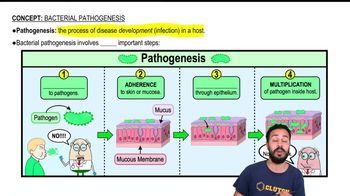
Pathogenesis of Pseudomonas in Conjunctivitis

Pseudomonas species are opportunistic pathogens that can cause conjunctivitis by infecting the eye's mucous membranes. Understanding how Pseudomonas causes infection helps determine whether its presence in a sample is likely to be the cause of the patient's symptoms.
Recommended video:
Guided course
02:35
Intro to Bacterial Pathogenesis

Contamination vs. Infection Source

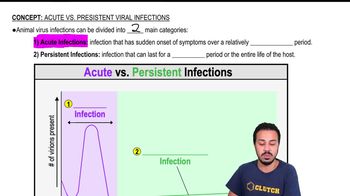
Distinguishing between contamination and the actual source of infection is crucial. Contamination means the organism is present but not necessarily causing disease, while the source implies the organism originated from that item and caused the infection.
Recommended video:
Guided course
02:59
Acute vs. Persistent Viral Infections

Microbial Growth in Cosmetics

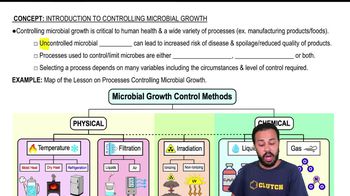
Microorganisms like Pseudomonas can grow in cosmetics such as mascara if preservatives fail or contamination occurs. Recognizing microbial growth in such products helps assess whether the product could be a reservoir for infection.
Recommended video:
Guided course
04:56
Introduction to Controlling Microbial Growth