Ch. 18 - Practical Applications of Immunology
Tortora - Microbiology: An Introduction 14th Edition
Tortora14th EditionMicrobiology: An IntroductionISBN: 9780138200398Not the one you use?Change textbook
Chapter 18, Problem 5

Explain the effects of excess antigen and antibody on the precipitation reaction. How is the precipitin ring test different from an immunodiffusion test?

Verified step by step guidance
1
Understand the precipitation reaction: it occurs when soluble antigens and antibodies interact to form an insoluble complex that precipitates out of solution. The amount and ratio of antigen to antibody influence the formation of these complexes.
Explain the effect of excess antigen (antigen excess): when there is more antigen than antibody, small soluble complexes form that do not precipitate well, leading to a decrease or absence of visible precipitation. This is called the prozone effect.
Explain the effect of excess antibody (antibody excess): when there is more antibody than antigen, small soluble complexes also form, preventing lattice formation and precipitation. This is known as the postzone effect.
Describe the precipitin ring test: it is a qualitative test where antigen and antibody solutions are layered in a tube, and a visible ring of precipitate forms at the zone of optimal antigen-antibody equivalence, indicating precipitation.
Contrast with the immunodiffusion test: in immunodiffusion, antigen and antibody diffuse through a gel medium (such as agar), and precipitation lines form where optimal concentrations meet. This allows for more detailed analysis of antigen-antibody interactions and can detect multiple antigens or antibodies.

Verified video answer for a similar problem:

This video solution was recommended by our tutors as helpful for the problem above.
Video duration:
2m
Was this helpful?

Key Concepts

Here are the essential concepts you must grasp in order to answer the question correctly.

Precipitation Reaction and Antigen-Antibody Interaction

A precipitation reaction occurs when soluble antigens and antibodies form insoluble complexes. The ratio of antigen to antibody is critical; excess antigen or antibody can prevent optimal lattice formation, reducing visible precipitation. This phenomenon is known as the prozone (excess antibody) or postzone (excess antigen) effect.
Recommended video:
Guided course
09:16
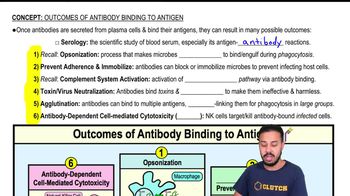
Outcomes of Antibody Binding to Antigen

Precipitin Ring Test

The precipitin ring test is a qualitative assay where antigen and antibody solutions are layered in a tube, forming a visible ring of precipitate at the interface if they react. It is simple and rapid, primarily used to detect the presence of specific antibodies or antigens in a sample.
Recommended video:
Guided course
06:59
The Ames Test

Immunodiffusion Test

Immunodiffusion involves the diffusion of antigen and antibody in a gel, forming precipitin lines where they meet at optimal concentrations. Unlike the precipitin ring test, it allows for the analysis of multiple antigens or antibodies simultaneously and can provide information about identity, partial identity, or non-identity of antigens.
Recommended video:
Guided course
06:59
The Ames Test