Ch. 17 - Adaptive Immunity: Specific Defenses of the Host
Tortora - Microbiology: An Introduction 14th Edition
Tortora14th EditionMicrobiology: An IntroductionISBN: 9780138200398Not the one you use?Change textbook
Chapter 17, Problem 8

Put the following in the correct sequence to elicit an antibody response:
(1) TH cell produces cytokines
(2) B cell contacts antigen
(3) antigen fragment goes to surface of the B cell
(4) TH recognizes antigen fragment and MHC
(5) B cell proliferates.
a. 1, 2, 3, 4, 5
b. 5, 4, 3, 2, 1
c. 3, 4, 5, 1, 2
d. 2, 3, 4, 1, 5
e. 4, 5, 3, 1, 2

Verified step by step guidance
1
Step 1: Identify the initial event in the antibody response, which is the B cell encountering and binding to the specific antigen. This corresponds to 'B cell contacts antigen'.
Step 2: After antigen binding, the B cell processes the antigen and presents an antigen fragment on its surface bound to MHC molecules. This is 'antigen fragment goes to surface of the B cell'.
Step 3: Next, a T helper (TH) cell recognizes the antigen fragment presented by the B cell along with the MHC molecule. This is 'TH recognizes antigen fragment and MHC'.
Step 4: Upon recognition, the TH cell becomes activated and produces cytokines that help stimulate the B cell. This corresponds to 'TH cell produces cytokines'.
Step 5: Finally, the B cell, now activated by the cytokines, proliferates and differentiates to produce antibodies. This is 'B cell proliferates'.

Verified video answer for a similar problem:

This video solution was recommended by our tutors as helpful for the problem above.
Video duration:
3m
Was this helpful?

Key Concepts

Here are the essential concepts you must grasp in order to answer the question correctly.

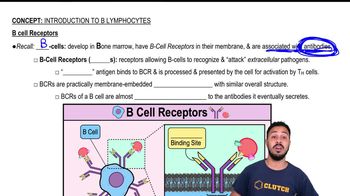
B Cell Antigen Recognition and Processing

B cells recognize and bind specific antigens through their surface receptors. After binding, the antigen is internalized, processed, and fragments are presented on the B cell surface bound to MHC class II molecules, enabling interaction with helper T cells.
Recommended video:
Guided course
04:37
B cell Receptors

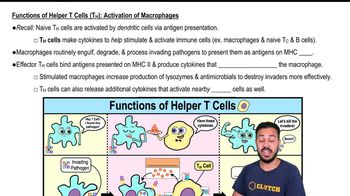
Helper T Cell Activation and Cytokine Production

Helper T (TH) cells recognize antigen fragments presented by B cells via MHC class II molecules. Upon recognition, TH cells become activated and secrete cytokines, which provide essential signals to B cells for their activation and differentiation.
Recommended video:
Guided course
05:18
Functions of Helper T Cells (TH):Activation of Macrophages

B Cell Proliferation and Antibody Production

Following activation by cytokines from helper T cells, B cells proliferate and differentiate into plasma cells. These plasma cells produce and secrete antibodies specific to the original antigen, constituting the humoral immune response.
Recommended video:
Guided course
04:37
B cell Receptors