Ch. 17 - Adaptive Immunity: Specific Defenses of the Host
Tortora - Microbiology: An Introduction 14th Edition
Tortora14th EditionMicrobiology: An IntroductionISBN: 9780138200398Not the one you use?Change textbook
Chapter 17, Problem 9

A kidney-transplant patient experienced a cytotoxic rejection of the new kidney. Place the following in order for that rejection:
(1) apoptosis occurs
(2) CD8⁺ T cell becomes CTL
(3) granzymes released
(4) MHC class I activates CD8⁺ T cell
(5) perforin released
a. 1, 2, 3, 4, 5
b. 5, 4, 3, 2, 1
c. 4, 2, 5, 3, 1
d. 3, 4, 5, 1, 2
e. 2, 3, 4, 1, 5

Verified step by step guidance
1
Step 1: Understand that cytotoxic rejection involves CD8⁺ T cells recognizing the transplanted kidney cells as foreign through MHC class I molecules presenting antigen. This recognition activates the CD8⁺ T cell.
Step 2: Once activated by MHC class I, the CD8⁺ T cell differentiates into a cytotoxic T lymphocyte (CTL), which is capable of killing target cells.
Step 3: The CTL then releases perforin, a protein that forms pores in the target cell membrane, allowing entry of other molecules.
Step 4: Following perforin pore formation, granzymes are released into the target cell through these pores; granzymes are serine proteases that trigger apoptosis inside the target cell.
Step 5: Finally, apoptosis occurs in the target kidney cells, leading to cell death and contributing to the rejection of the transplanted organ.

Verified video answer for a similar problem:

This video solution was recommended by our tutors as helpful for the problem above.
Video duration:
3m
Was this helpful?

Key Concepts

Here are the essential concepts you must grasp in order to answer the question correctly.

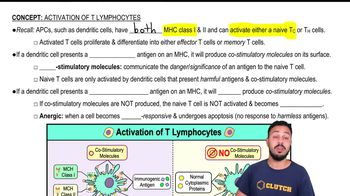
Activation of CD8⁺ T Cells by MHC Class I

Cytotoxic T lymphocytes (CTLs) are activated when their T cell receptors recognize antigenic peptides presented by MHC class I molecules on target cells. This activation is the initial step that triggers the CD8⁺ T cell to differentiate into an effector CTL capable of killing infected or foreign cells.
Recommended video:
Guided course
07:33
Activation of T Lymphocytes

Mechanism of Target Cell Killing by CTLs

Activated CTLs kill target cells by releasing cytotoxic molecules such as perforin and granzymes. Perforin forms pores in the target cell membrane, allowing granzymes to enter and induce apoptosis, effectively eliminating the harmful or foreign cells.
Recommended video:
Guided course
03:50
SOS Repair System

Apoptosis Induction in Cytotoxic Rejection

Apoptosis is a programmed cell death process triggered in target cells by granzymes delivered through perforin pores. This controlled cell death prevents inflammation and tissue damage, playing a key role in cytotoxic rejection during organ transplantation.
Recommended video:
Guided course
04:27
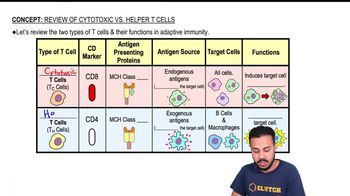
Review of Cytotoxic vs Helper T Cells