
Ch. 17 - Adaptive Immunity: Specific Defenses of the Host
Tortora - Microbiology: An Introduction 14th Edition
Tortora14th EditionMicrobiology: An IntroductionISBN: 9780138200398Not the one you use?Change textbook
Chapter 17, Problem 1

Contrast the terms in the following pairs:
a. Innate and adaptive immunity
b. Humoral and cellular immunity
c. Active and passive immunity
d. TH1 and TH2 cells
e. Natural and artificial immunity
f. T-dependent and T-independent antigens
g. Immunoglobulin and TCR

Verified step by step guidance
1
For each pair, start by defining the first term clearly, focusing on its key characteristics and role in the immune system.
Next, define the second term in the pair, highlighting how it differs from the first term in function, mechanism, or origin.
Compare the two definitions side-by-side to emphasize the main contrasts, such as innate vs. adaptive immunity being immediate and non-specific versus delayed and specific responses.
Use examples where appropriate to illustrate differences, for instance, humoral immunity involving antibodies produced by B cells, while cellular immunity involves T cells directly attacking infected cells.
Summarize each pair by stating the fundamental distinction, ensuring you understand how these concepts fit into the broader context of immunology.

Verified video answer for a similar problem:

This video solution was recommended by our tutors as helpful for the problem above.
Video duration:
3m
Was this helpful?

Key Concepts

Here are the essential concepts you must grasp in order to answer the question correctly.

Innate and Adaptive Immunity

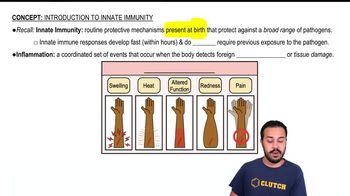
Innate immunity is the body's first line of defense, providing immediate, non-specific protection against pathogens. Adaptive immunity develops later, is specific to particular antigens, and involves memory for faster responses upon re-exposure. Innate immunity includes barriers and phagocytes, while adaptive immunity relies on lymphocytes like B and T cells.
Recommended video:
Guided course
02:30
Introduction to Innate Immunity

Humoral and Cellular Immunity

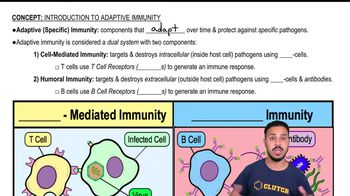
Humoral immunity involves B cells producing antibodies that neutralize pathogens in body fluids. Cellular immunity is mediated by T cells that directly kill infected cells or help other immune cells. Both arms work together to eliminate infections, with humoral targeting extracellular pathogens and cellular targeting intracellular pathogens.
Recommended video:
Guided course
05:47
Introduction to Adaptive Immunity

Active and Passive Immunity

Active immunity arises when the body produces its own antibodies and memory cells after exposure to an antigen, either through infection or vaccination. Passive immunity is the transfer of pre-formed antibodies from another source, providing immediate but temporary protection without memory formation.
Recommended video:
Guided course
04:18
Passive vs. Active Transport