Ch. 14 - Principles of Disease and Epidemiology
Tortora - Microbiology: An Introduction 14th Edition
Tortora14th EditionMicrobiology: An IntroductionISBN: 9780138200398Not the one you use?Change textbook
Chapter 14, Problem 1

The emergence of new infectious diseases is probably due to all of the following except:
a. The need of bacteria to cause disease
b. The ability of humans to travel by air
c. Changing environments (e.g., flood, drought, pollution)
d. A pathogen crossing the species barrier
e. The increasing human population

Verified step by step guidance
1
Step 1: Understand the question is asking to identify the option that is NOT a likely cause for the emergence of new infectious diseases.
Step 2: Review each option carefully to determine if it logically contributes to the emergence of new infectious diseases.
Step 3: Analyze option (a) 'the need of bacteria to cause disease' — consider whether bacteria inherently need to cause disease or if disease causation is incidental to their survival.
Step 4: Evaluate options (b) through (e) which include factors like human travel, environmental changes, species barrier crossing, and population growth, all known to influence disease emergence.
Step 5: Conclude that the correct answer is the option that does not align with scientific understanding of disease emergence, focusing on the biological necessity of bacteria to cause disease.

Verified video answer for a similar problem:

This video solution was recommended by our tutors as helpful for the problem above.
Video duration:
3m
Was this helpful?

Key Concepts

Here are the essential concepts you must grasp in order to answer the question correctly.

Pathogen Evolution and Virulence

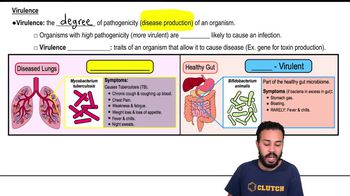
Pathogens evolve over time, but they do not inherently need to cause disease to survive. Many microbes exist harmlessly or beneficially. Virulence can be a byproduct of adaptation, not a necessity, meaning the emergence of new diseases is not driven by a bacterial 'need' to cause illness.
Recommended video:

Factors Contributing to Disease Emergence

New infectious diseases often arise due to environmental changes, increased human population density, global travel, and pathogens crossing species barriers. These factors facilitate the spread and evolution of microbes, increasing the chances of novel infections.
Recommended video:
Guided course
01:55
Growth Factors

Zoonosis and Species Barrier Crossing

Zoonosis refers to diseases transmitted from animals to humans. When pathogens cross species barriers, they can cause new infectious diseases in humans. This process is a key driver in the emergence of novel infections, especially with increased human-animal interactions.
Recommended video:
Guided course
01:09
Chemical Barriers