Ch. 14 - Principles of Disease and Epidemiology
Tortora - Microbiology: An Introduction 14th Edition
Tortora14th EditionMicrobiology: An IntroductionISBN: 9780138200398Not the one you use?Change textbook
Chapter 14, Problem 2

Define symbiosis. Differentiate commensalism, mutualism, and parasitism, and give an example of each.

Verified step by step guidance
1
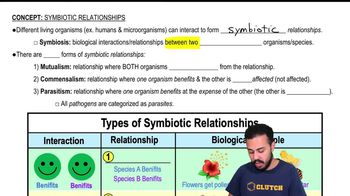
Start by defining symbiosis as a close and long-term biological interaction between two different biological organisms, which can be beneficial, neutral, or harmful to one or both parties involved.
Explain commensalism as a type of symbiotic relationship where one organism benefits while the other is neither helped nor harmed. For example, certain bacteria living on human skin benefit from nutrients without affecting the host.
Describe mutualism as a symbiotic relationship where both organisms benefit from the interaction. An example is the relationship between nitrogen-fixing bacteria (Rhizobium) and leguminous plants, where bacteria fix nitrogen for the plant and receive carbohydrates in return.
Define parasitism as a relationship where one organism (the parasite) benefits at the expense of the other (the host), often causing harm. An example is the tapeworm living in the intestines of mammals, absorbing nutrients and harming the host.
Summarize the key differences by focusing on the effect on each organism: commensalism (one benefits, other unaffected), mutualism (both benefit), and parasitism (one benefits, other harmed).

Verified video answer for a similar problem:

This video solution was recommended by our tutors as helpful for the problem above.
Video duration:
3m
Was this helpful?

Key Concepts

Here are the essential concepts you must grasp in order to answer the question correctly.

Symbiosis

Symbiosis refers to a close and long-term biological interaction between two different organisms, which can be beneficial, neutral, or harmful to one or both parties. It encompasses various types of relationships based on how the organisms affect each other.
Recommended video:
Guided course
05:59
Symbiotic Relationships

Commensalism

Commensalism is a type of symbiotic relationship where one organism benefits while the other is neither helped nor harmed. An example is barnacles attaching to whales, gaining mobility and food particles without affecting the whale.
Recommended video:
Guided course
05:59
Symbiotic Relationships

Mutualism and Parasitism

Mutualism is a symbiotic relationship where both organisms benefit, such as bees pollinating flowers while obtaining nectar. Parasitism benefits one organism (the parasite) at the expense of the other (the host), like tapeworms living in the intestines of animals.
Recommended video:
Guided course
05:59
Symbiotic Relationships
Related Practice
Textbook Question

Differentiate the terms in each of the following pairs:

a. Etiology and pathogenesis

b. Infection and disease

c. Communicable disease and noncommunicable disease

Textbook Question

Which of the following statements is false?

a. E. coli never causes disease

b. E. coli provides vitamin K for its host

c. E. coli often exists in a mutualistic relationship with humans

d. A disease-causing strain of E. coli causes bloody diarrhea

1
views
Textbook Question

All members of a group of ornithologists studying barn owls in the wild have had

salmonellosis (Salmonella gastroenteritis). One birder is experiencing her third infection. What is the most likely source of their infections?

a. The ornithologists are eating the same food.

b. They are contaminating their hands while handling the owls and nests.

c. One of the workers is a Salmonella carrier.

d. Their drinking water is contaminated.

4
views
Textbook Question

The emergence of new infectious diseases is probably due to all of the following except:

a. The need of bacteria to cause disease

b. The ability of humans to travel by air

c. Changing environments (e.g., flood, drought, pollution)

d. A pathogen crossing the species barrier

e. The increasing human population

4
views
Textbook Question

Indicate whether each of the following conditions is typical of subacute, chronic, or acute infections.

a. The patient experiences a rapid onset of malaise; symptoms last 5 days

b. The patient experiences cough and breathing difficulty for months

c. The patient has no apparent symptoms and is a known carrier

1
views