Ch. 12 - The Eukaryotes: Fungi, Algae, Protozoa, and Helminths
Tortora - Microbiology: An Introduction 14th Edition
Tortora14th EditionMicrobiology: An IntroductionISBN: 9780138200398Not the one you use?Change textbook
Chapter 12, Problem 1

How many phyla are represented in the following list of organisms: Echinococcus, Cyclospora, Aspergillus, Taenia, Toxoplasma, Trichinella?
a. 1
b. 2
c. 3
d. 4
e. 5

Verified step by step guidance
1
Identify the taxonomic classification of each organism in the list, focusing on their phylum level. The organisms are: Echinococcus, Cyclospora, Aspergillus, Taenia, Toxoplasma, and Trichinella.
Determine the phylum for each organism: For example, Echinococcus and Taenia are tapeworms, which belong to the phylum Platyhelminthes; Trichinella is a nematode, belonging to the phylum Nematoda; Aspergillus is a fungus, classified under the phylum Ascomycota; Cyclospora and Toxoplasma are protozoan parasites, both belonging to the phylum Apicomplexa.
List the distinct phyla identified from the organisms: Platyhelminthes, Nematoda, Ascomycota, and Apicomplexa.
Count the number of unique phyla from the list to determine how many phyla are represented among the organisms.
Match the count of unique phyla to the multiple-choice options provided to select the correct answer.

Verified video answer for a similar problem:

This video solution was recommended by our tutors as helpful for the problem above.
Was this helpful?

Key Concepts

Here are the essential concepts you must grasp in order to answer the question correctly.

Taxonomic Classification and Phyla

Taxonomy organizes living organisms into hierarchical groups based on shared characteristics, with phylum being a major rank below kingdom. Understanding phyla helps categorize organisms by fundamental body plans and genetic relationships, which is essential for identifying how many distinct groups are represented in a list of species.
Recommended video:
Guided course
04:56
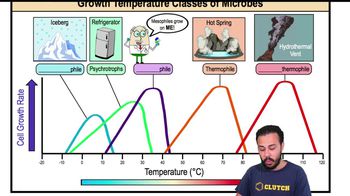
Classification of Microbes by Growth Temperature

Characteristics of the Listed Organisms

Each organism in the list belongs to a specific phylum: Echinococcus and Taenia are flatworms (Phylum Platyhelminthes), Trichinella is a roundworm (Phylum Nematoda), Cyclospora and Toxoplasma are protozoan parasites (Phylum Apicomplexa), and Aspergillus is a fungus (Phylum Ascomycota). Recognizing these classifications is key to counting distinct phyla.
Recommended video:
Guided course
05:22
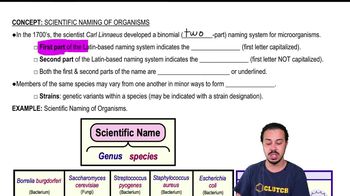
Scientific Naming of Organisms

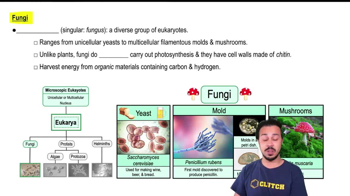
Distinguishing Between Protozoa and Fungi

Protozoa are single-celled eukaryotes often classified in various phyla like Apicomplexa, while fungi are multicellular eukaryotes with distinct phyla such as Ascomycota. Differentiating these groups clarifies the diversity of phyla present among the organisms listed.
Recommended video: