
Ch. 10 - Classification of Microorganisms
Tortora - Microbiology: An Introduction 14th Edition
Tortora14th EditionMicrobiology: An IntroductionISBN: 9780138200398Not the one you use?Change textbook
Chapter 10, Problem 3

Which of the following is used to classify organisms into the Kingdom Fungi?
a. Ability to photosynthesize; possess a cell wall
b. Unicellular; possess cell wall; prokaryotic
c. Unicellular; lacking cell wall; eukaryotic
d. Absorptive; possess cell wall; eukaryotic
e. Ingestive; lacking cell wall; multicellular; prokaryotic

Verified step by step guidance
1
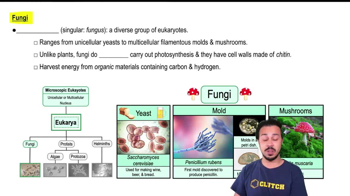
Step 1: Understand the key characteristics of the Kingdom Fungi. Fungi are eukaryotic organisms that have cell walls and obtain nutrients through absorption rather than photosynthesis or ingestion.
Step 2: Analyze each option by comparing its features to the known characteristics of fungi:
Step 3: Option (a) mentions the ability to photosynthesize, which fungi do not have, so this option can be excluded.
Step 4: Option (b) describes prokaryotic organisms with cell walls, but fungi are eukaryotic, so this option is incorrect.
Step 5: Option (d) describes organisms that are absorptive, possess a cell wall, and are eukaryotic, which matches the defining traits of fungi.

Verified video answer for a similar problem:

This video solution was recommended by our tutors as helpful for the problem above.
Was this helpful?

Key Concepts

Here are the essential concepts you must grasp in order to answer the question correctly.

Characteristics of Kingdom Fungi

Kingdom Fungi includes organisms that are primarily absorptive heterotrophs, meaning they obtain nutrients by absorbing dissolved molecules. They possess cell walls made of chitin and are eukaryotic, having membrane-bound organelles. Fungi can be unicellular or multicellular but do not perform photosynthesis.
Recommended video:

Eukaryotic vs. Prokaryotic Cells

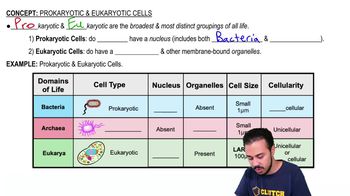
Eukaryotic cells have a defined nucleus and membrane-bound organelles, distinguishing them from prokaryotic cells, which lack these features. Fungi are eukaryotes, unlike bacteria and archaea, which are prokaryotes. This distinction is crucial for classifying organisms correctly.
Recommended video:
Guided course
05:54
Prokaryotic & Eukaryotic Cells

Modes of Nutrition in Microorganisms

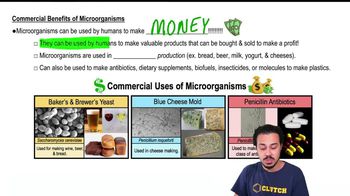
Organisms can obtain nutrients through photosynthesis, ingestion, or absorption. Fungi are absorptive heterotrophs, absorbing nutrients from their environment after external digestion. This contrasts with photosynthetic plants and ingestive animals, helping differentiate fungi from other kingdoms.
Recommended video:
Guided course
03:17
Commercial Benefits of Microorganisms
Related Practice
Textbook Question

Bacillus and Lactobacillus are not in the same order. This indicates that which one of the following is not sufficient to assign an organism to a taxon?

a. Biochemical characteristics

b. Amino acid sequencing

c. Phage typing

d. Serology

e. Morphological characteristics

2
views
Textbook Question

Which of the following is false about scientific nomenclature?

a. Each name is specific.

b. Names vary with geographical location.

c. The names are standardized.

d. Each name consists of a genus and specific epithet.

e. It was first designed by Linnaeus.

2
views
Textbook Question

Here is some additional information on the organisms in question 1:

Which of these organisms are most closely related? Compare this answer with your response to review question 1.

1
views
Textbook Question

Bergey’s Manual of Systematics of Archaea and Bacteria differs from Bergey’s Manual of Determinative Bacteriology in that the former

a. Groups bacteria into species

b. Groups bacteria according to phylogenetic relationships

c. Groups bacteria according to pathogenic properties

d. Groups bacteria into 19 species

e. All of the above

5
views
Textbook Question

DRAW IT Use the following rRNA information to construct a cladogram for some of the organisms used in question 4. What is the purpose of a cladogram? How does your cladogram differ from a dichotomous key for these organisms?

Textbook Question

Use the information in the following table to complete the dichotomous key to these organisms. What is the purpose of a dichotomous key? Look up each genus in Chapter 11, and provide an example of why this organism is of interest to humans.

5
views