
Ch. 10 - Classification of Microorganisms
Tortora - Microbiology: An Introduction 14th Edition
Tortora14th EditionMicrobiology: An IntroductionISBN: 9780138200398Not the one you use?Change textbook
Chapter 10, Problem 4

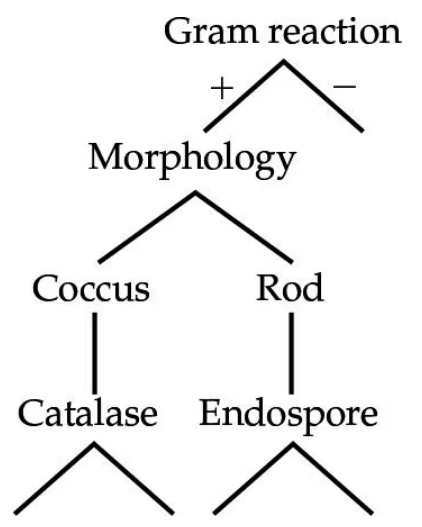
Use the information in the following table to complete the dichotomous key to these organisms. What is the purpose of a dichotomous key? Look up each genus in Chapter 11, and provide an example of why this organism is of interest to humans.
Dichotomous key diagram classifying organisms by Gram reaction, morphology, catalase presence, and endospore formation.

Verified step by step guidance
1
Understand that a dichotomous key is a tool used to identify organisms by making a series of choices between two characteristics at each step, ultimately leading to the identification of the organism.
Examine the table carefully to identify distinguishing characteristics of each organism, such as shape, Gram stain, metabolic properties, or other traits provided.
Start constructing the dichotomous key by creating paired statements (couplets) that separate the organisms based on one characteristic at a time, for example: '1a. Organism is Gram-positive' versus '1b. Organism is Gram-negative.'
Continue the key by further dividing groups from each choice until each organism can be uniquely identified by following the path of choices.
For each genus listed, refer to Chapter 11 to find relevant information about its significance to humans, such as its role in disease, industry, or ecology, and summarize why it is important.

Verified video answer for a similar problem:

This video solution was recommended by our tutors as helpful for the problem above.
Video duration:
2m
Was this helpful?

Key Concepts

Here are the essential concepts you must grasp in order to answer the question correctly.

Dichotomous Key

A dichotomous key is a tool used to identify organisms by answering a series of yes/no or either/or questions based on observable traits. It helps systematically narrow down possibilities until the organism is identified. This method is widely used in microbiology for classifying bacteria and other microorganisms.
Recommended video:
Guided course
04:26
Recap:Prokaryotic vs. Eukaryotic Cells

Genus and Taxonomy

The genus is a taxonomic rank used to group species that share common characteristics. Understanding the genus helps in classifying organisms and predicting traits or behaviors. In microbiology, knowing the genus aids in identifying pathogens, beneficial microbes, or industrially important species.
Recommended video:
Guided course
02:19
Introduction to Taxonomy

Human Relevance of Microorganisms

Many microorganisms impact humans positively or negatively, such as causing disease, aiding digestion, or producing antibiotics. Studying the genus of microbes reveals their roles in health, industry, or ecology. This knowledge is essential for medical treatment, biotechnology, and environmental management.
Recommended video:
Guided course
03:25
The Human Microbiome
Related Practice
Textbook Question

Which of the following is false about scientific nomenclature?

a. Each name is specific.

b. Names vary with geographical location.

c. The names are standardized.

d. Each name consists of a genus and specific epithet.

e. It was first designed by Linnaeus.

2
views
Textbook Question

Use the following choices to answer questions 7 and 8.

a. Animalia

b. Fungi

c. Plantae

d. Bacillota (gram-positive bacteria)

e. Pseudomonadota (gram-negative bacteria)

Into which group would you place a multicellular organism that has a mouth and lives inside the human liver?

Textbook Question

Which of the following is used to classify organisms into the Kingdom Fungi?

a. Ability to photosynthesize; possess a cell wall

b. Unicellular; possess cell wall; prokaryotic

c. Unicellular; lacking cell wall; eukaryotic

d. Absorptive; possess cell wall; eukaryotic

e. Ingestive; lacking cell wall; multicellular; prokaryotic

1
views
Textbook Question

Use the key in the Clinical Focus box to identify the gram-negative, oxidase-positive rod causing pneumonia in a sea otter. It is H2S-positive, indole-negative, and urease-positive.

1
views
Textbook Question

You could identify an unknown bacterium by all of the following except

a. hybridizing a DNA probe from a known bacterium with the unknown’s DNA.

b. making a fatty acid profile of the unknown.

c. specific antiserum agglutinating the unknown.

d. ribosomal RNA sequencing.

e. percentage of guanine + cytosine.

5
views
Textbook Question

DRAW IT Use the following rRNA information to construct a cladogram for some of the organisms used in question 4. What is the purpose of a cladogram? How does your cladogram differ from a dichotomous key for these organisms?