How might phage conversion provide a bacterium with an evolutionary advantage?
Ch. 6 - Viruses and Prions

Norman-McKay2nd EditionMicrobiology: Basic and Clinical PrinciplesISBN: 9780137661619Not the one you use?Change textbook
Chapter 6, Problem 3
Assume a new enveloped RNA virus is causing an epidemic. Which of the following may be useful to manage the disease? Select all that apply.
a. Injectable antibodies
b. Interferons
c. Antibiotics
d. Nucleoside analogs
Verified step by step guidance1
Step 1: Understand the nature of the virus. Since it is an enveloped RNA virus, it means the virus has a lipid membrane and its genetic material is RNA, which influences treatment options.
Step 2: Evaluate the use of injectable antibodies (option a). These can provide passive immunity by directly neutralizing the virus, which is often useful in managing viral infections.
Step 3: Consider interferons (option b). Interferons are signaling proteins released by host cells in response to viral infections and can boost the immune response, making them potentially useful against RNA viruses.
Step 4: Assess the role of antibiotics (option c). Antibiotics target bacteria, not viruses, so they are generally ineffective against viral infections unless there is a secondary bacterial infection.
Step 5: Analyze nucleoside analogs (option d). These are antiviral drugs that mimic nucleosides and interfere with viral RNA replication, making them a common treatment strategy for RNA viruses.

Verified video answer for a similar problem:
This video solution was recommended by our tutors as helpful for the problem above.
Video duration:
3mWas this helpful?
Key Concepts
Here are the essential concepts you must grasp in order to answer the question correctly.
Enveloped RNA Virus Characteristics
Enveloped RNA viruses have a lipid membrane surrounding their RNA genome, which influences how they enter host cells and evade the immune system. Understanding their structure helps in targeting treatments that disrupt viral entry or replication.
Recommended video:
Guided course
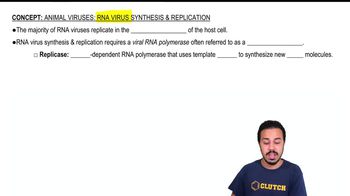
Animal Viruses: RNA Virus Synthesis & Replication
Antiviral Agents and Their Mechanisms
Antiviral agents like nucleoside analogs mimic viral nucleotides, interfering with viral RNA replication. Injectable antibodies can provide passive immunity by neutralizing the virus, while interferons boost the host immune response to inhibit viral replication.
Recommended video:
Guided course
Liquid Chemicals: Surface-Active Agents
Limitations of Antibiotics in Viral Infections
Antibiotics target bacterial structures and processes, making them ineffective against viruses. Using antibiotics for viral infections does not treat the virus and can contribute to antibiotic resistance.
Recommended video:
Guided course
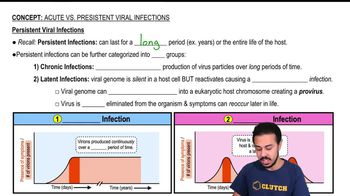
Persistent Viral Infections
Related Practice
Textbook Question
1
views
Textbook Question
Compare and contrast production of viral proteins for dsDNA viruses and ssRNA+ viruses.
1
views
Textbook Question
An accidental needle stick occurs during the routine treatment of an HIV-positive patient who arrives at your clinic. Immediate administration of _______________ can block viral entry.
a. Enfuvirtide
b. Vapendavir
c. AZT
d. Amantadine
2
views
Textbook Question
A young mother who has hepatitis B is under your care. Your main concern is to prevent the spread of the virus from infected cells to healthy ones. You would recommend:
a. Acyclovir
b. Retrovir
c. Interferon
d. Valtrex
2
views
Textbook Question
An RNA virus with an antisense or negative strand must have which of the following enzymes to replicate?
a. Reverse transcriptase
b. Host DNA polymerase
c. RNA-dependent RNA polymerase
d. Host RNA polymerase
1
views