How might phage conversion provide a bacterium with an evolutionary advantage?
Ch. 6 - Viruses and Prions

Norman-McKay2nd EditionMicrobiology: Basic and Clinical PrinciplesISBN: 9780137661619Not the one you use?Change textbook
Chapter 6, Problem 5
An accidental needle stick occurs during the routine treatment of an HIV-positive patient who arrives at your clinic. Immediate administration of _______________ can block viral entry.
a. Enfuvirtide
b. Vapendavir
c. AZT
d. Amantadine
Verified step by step guidance1
Step 1: Understand the context of the problem, which involves an accidental needle stick exposure to HIV, a virus that infects host cells by entering them.
Step 2: Recall that blocking viral entry means preventing the virus from fusing with or penetrating the host cell membrane, which stops infection at the earliest stage.
Step 3: Review the mechanisms of the drugs listed: enfuvirtide is a fusion inhibitor that blocks HIV from entering cells; vapendavir targets rhinoviruses; AZT is a reverse transcriptase inhibitor acting after viral entry; amantadine blocks influenza virus uncoating.
Step 4: Identify that the drug effective in blocking HIV viral entry immediately after exposure is enfuvirtide, as it specifically inhibits the fusion of HIV with the host cell membrane.
Step 5: Conclude that immediate administration of enfuvirtide can block viral entry in this scenario.

Verified video answer for a similar problem:
This video solution was recommended by our tutors as helpful for the problem above.
Video duration:
3mWas this helpful?
Key Concepts
Here are the essential concepts you must grasp in order to answer the question correctly.
HIV Viral Entry Mechanism
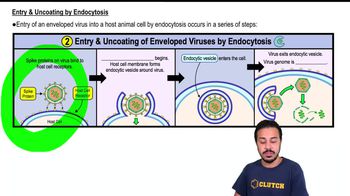
HIV enters host cells by binding its envelope glycoproteins to CD4 receptors and co-receptors on the cell surface, followed by fusion of the viral and cellular membranes. Blocking this entry step prevents the virus from infecting new cells, which is critical in early intervention after exposure.
Recommended video:
Guided course
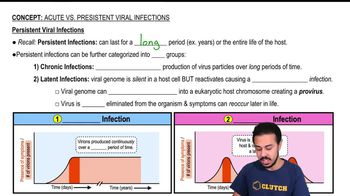
Persistent Viral Infections
Enfuvirtide as an Entry Inhibitor
Enfuvirtide is a fusion inhibitor that binds to the HIV gp41 protein, preventing the conformational changes needed for viral fusion with the host cell membrane. It is used to block HIV entry into cells, making it effective for post-exposure prophylaxis immediately after potential exposure.
Recommended video:
Guided course
Entry & Uncoating by Endocytosis
Post-Exposure Prophylaxis (PEP) for HIV
PEP involves administering antiretroviral drugs soon after potential HIV exposure to prevent infection. Drugs that block viral entry, like enfuvirtide, are crucial in the initial phase, while reverse transcriptase inhibitors like AZT act later in the viral replication cycle.
Recommended video:
Guided course
Post-Translational Modification
Related Practice
Textbook Question
1
views
Textbook Question
Compare and contrast production of viral proteins for dsDNA viruses and ssRNA+ viruses.
1
views
Textbook Question
The patient has a viral titer of 200 on day four after infection, 30 at 4 weeks after infection, 600 at 8 months after infection, and 23 after 1 year of infection. This is likely a(n) _______________ infection.
2
views
Textbook Question
Assume a new enveloped RNA virus is causing an epidemic. Which of the following may be useful to manage the disease? Select all that apply.
a. Injectable antibodies
b. Interferons
c. Antibiotics
d. Nucleoside analogs
2
views
Textbook Question
Match the following terms.
2
views
Textbook Question
A young mother who has hepatitis B is under your care. Your main concern is to prevent the spread of the virus from infected cells to healthy ones. You would recommend:
a. Acyclovir
b. Retrovir
c. Interferon
d. Valtrex
2
views