Ch. 4 - Introduction to Eukaryotic Cells
Norman-McKay- Microbiology: Basic and Clinical Principles 2nd Edition
Norman-McKay2nd EditionMicrobiology: Basic and Clinical PrinciplesISBN: 9780137661619Not the one you use?Change textbook
Chapter 4, Problem 1

Which of the following include eukaryotic cells? Select all that apply.
a. Fungi
b. Yeasts
c. Protista
d. Bacteria
e. Helminths
f. Animalia
g. Archaea
h. Plantae

Verified step by step guidance
1
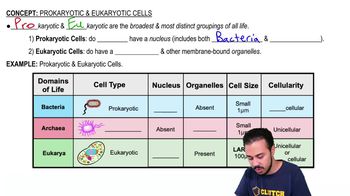
Step 1: Understand the difference between prokaryotic and eukaryotic cells. Eukaryotic cells have a true nucleus enclosed by a membrane and membrane-bound organelles, while prokaryotic cells lack a nucleus and membrane-bound organelles.
Step 2: Identify which groups listed are composed of eukaryotic organisms. Recall that fungi, protists, helminths, animals, and plants are all eukaryotic.
Step 3: Recognize that yeasts are a type of fungi, so they are also eukaryotic.
Step 4: Note that bacteria and archaea are prokaryotic domains, meaning they do not have eukaryotic cells.
Step 5: Based on this classification, select all options that represent eukaryotic groups: fungi (including yeasts), protista, helminths, animalia, and plantae.

Verified video answer for a similar problem:

This video solution was recommended by our tutors as helpful for the problem above.
Video duration:
2m
Was this helpful?

Key Concepts

Here are the essential concepts you must grasp in order to answer the question correctly.

Eukaryotic vs Prokaryotic Cells

Cells are classified as eukaryotic or prokaryotic based on their structure. Eukaryotic cells have a true nucleus enclosed by a membrane and contain membrane-bound organelles, while prokaryotic cells lack a nucleus and organelles. This distinction is fundamental for identifying which organisms belong to each category.
Recommended video:
Guided course
05:54
Prokaryotic & Eukaryotic Cells

Kingdoms Containing Eukaryotic Organisms

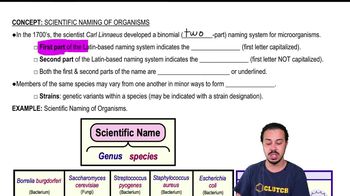
The major kingdoms that consist of eukaryotic organisms include Fungi, Protista, Animalia, and Plantae. These groups have cells with nuclei and complex structures. Understanding which kingdoms are eukaryotic helps in correctly classifying organisms like fungi, plants, animals, and protists.
Recommended video:
Guided course
05:22
Scientific Naming of Organisms

Characteristics of Specific Microbial Groups

Certain groups like yeasts (a type of fungi) and helminths (parasitic worms in Animalia) are eukaryotic, while bacteria and archaea are prokaryotic. Recognizing these characteristics aids in distinguishing between microbial types and their cellular organization.
Recommended video:
Guided course
03:37
Group Translocation