Ch. 4 - Introduction to Eukaryotic Cells
Norman-McKay- Microbiology: Basic and Clinical Principles 2nd Edition
Norman-McKay2nd EditionMicrobiology: Basic and Clinical PrinciplesISBN: 9780137661619Not the one you use?Change textbook
Chapter 4, Problem 4

Which of the following are characteristics of the Kingdom Fungi? Select all that apply.
a. They have a cell wall.
b. They are mainly unicellular.
c. They are mostly pathogens.
d. They contain peptidoglycan in their cell wall.
e. Some are photosynthetic.
f. They lack mitochondria.
g. They are prokaryotic and eukaryotic.

Verified step by step guidance
1
Step 1: Understand that Kingdom Fungi consists of eukaryotic organisms that have distinct cellular structures, including a cell wall, but unlike plants, their cell walls do not contain peptidoglycan.
Step 2: Recognize that fungi can be unicellular (like yeasts) or multicellular (like molds and mushrooms), so they are not mainly unicellular but include both forms.
Step 3: Note that while some fungi are pathogenic, many are saprophytic (decomposers) and play important ecological roles; thus, they are not mostly pathogens.
Step 4: Recall that fungi are not photosynthetic; they obtain nutrients by absorption, so they do not contain chlorophyll or perform photosynthesis.
Step 5: Remember that fungi have mitochondria for energy production and are strictly eukaryotic organisms, so they are neither prokaryotic nor lacking mitochondria.

Verified video answer for a similar problem:

This video solution was recommended by our tutors as helpful for the problem above.
Video duration:
2m
Was this helpful?

Key Concepts

Here are the essential concepts you must grasp in order to answer the question correctly.

Cell Structure of Fungi

Fungi are eukaryotic organisms characterized by having a rigid cell wall made primarily of chitin, not peptidoglycan. This cell wall provides structural support and protection, distinguishing them from bacteria, which have peptidoglycan in their walls.
Recommended video:
Guided course
05:59
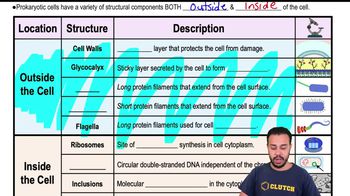
Overview of Prokaryotic Cell Structure

Fungal Morphology and Lifestyle

Most fungi are multicellular, forming complex structures like hyphae and mycelium, though some, like yeasts, are unicellular. They are primarily saprophytic or symbiotic rather than predominantly pathogenic, playing key roles in decomposition and nutrient cycling.
Recommended video:
Guided course
02:44
Types of Bacterial Cell Morphology

Metabolic and Cellular Characteristics

Fungi are non-photosynthetic heterotrophs that obtain nutrients by absorption. They possess mitochondria for energy production and are strictly eukaryotic, lacking any prokaryotic forms. This differentiates them from photosynthetic organisms and prokaryotes.
Recommended video:
Guided course
02:17
Introduction to Metabolism
Related Practice
Textbook Question

___________________ is also called cell drinking and is an example of an endocytic process.

8
views
Textbook Question

Which of the following are not characteristics of eukaryotes? Select all that apply.

a. They are generally simpler than prokaryotes.

b. They can be multicellular.

c. They all have a nucleus.

d. They tend to have multiple chromosomes.

e. They can have a cell wall.

f. They include pathogens.

g. They divide by mitosis.

h. They make up the Domain Archaea.

i. They make up the Domain Bacteria.

j. They make up the Domain Eukarya.

2
views
Textbook Question

Indicate the true statements about eukaryotic cells and then reword the false statements so that they are true.

a. Eukaryotic cells have 70S ribosomes on the rough endoplasmic reticulum.

b. Eukaryotic cells sexually reproduce by mitosis.

c. Eukaryotic cells can make up unicellular or multicellular organisms.

d. Eukaryotic cells always have a cell wall.

e. Eukaryotic cells can be photosynthetic.

f. Eukaryotic cells use fimbriae for motility.

g. Yeast is a multicellular eukaryote.

1
views
Textbook Question

___________________ is an exportation process used in eukaryotes and involves vesicles that may bud off the Golgi apparatus. In contrast, ___________________ is an importation process by which a solid or a dissolved substance enters the cell by being engulfed by invaginations of the plasma membrane.

2
views
Textbook Question

In what group of protozoans would you place the following organism? <IMAGE>

1
views
Textbook Question

Which of the following include eukaryotic cells? Select all that apply.

a. Fungi

b. Yeasts

c. Protista

d. Bacteria

e. Helminths

f. Animalia

g. Archaea

h. Plantae

1
views