Ch. 3 - Introduction to Prokaryotic Cells
Norman-McKay- Microbiology: Basic and Clinical Principles 2nd Edition
Norman-McKay2nd EditionMicrobiology: Basic and Clinical PrinciplesISBN: 9780137661619Not the one you use?Change textbook
Chapter 3, Problem 13

Describe what would occur if a cell with a damaged cell wall was placed in each of the following environments:
  • Isotonic environment
  • Hypertonic environment
  • Hypotonic environment

Verified step by step guidance
1
Step 1: Understand the role of the cell wall in maintaining cell integrity. The cell wall provides structural support and protects the cell from osmotic pressure changes, preventing it from bursting or collapsing.
Step 2: Consider what happens in an isotonic environment, where the solute concentration inside the cell equals that outside. Since there is no net movement of water, a cell with a damaged cell wall would likely maintain its shape but remain vulnerable to mechanical stress due to the weakened wall.
Step 3: Analyze the hypertonic environment scenario, where the external solute concentration is higher than inside the cell. Water will move out of the cell by osmosis, causing the cell to shrink (plasmolysis). A damaged cell wall may not prevent this shrinkage, and the cell could become dehydrated and lose function.
Step 4: Examine the hypotonic environment, where the external solute concentration is lower than inside the cell. Water will move into the cell, increasing internal pressure (turgor pressure). Normally, the cell wall prevents bursting, but with a damaged cell wall, the cell is at risk of lysing (bursting) due to the inability to withstand the osmotic pressure.
Step 5: Summarize the overall impact: In isotonic conditions, the cell remains stable but vulnerable; in hypertonic conditions, the cell shrinks; and in hypotonic conditions, the cell is at risk of bursting due to the compromised cell wall.

Verified video answer for a similar problem:

This video solution was recommended by our tutors as helpful for the problem above.
Video duration:
3m
Was this helpful?

Key Concepts

Here are the essential concepts you must grasp in order to answer the question correctly.

Cell Wall Function in Microbial Cells

The cell wall provides structural support and protection to microbial cells, preventing them from bursting in hypotonic environments. It maintains cell shape and counters osmotic pressure, especially important when water moves into the cell. Damage to the cell wall compromises these protective functions.
Recommended video:
Guided course
05:42
Cell Junctions

Osmosis and Tonicity

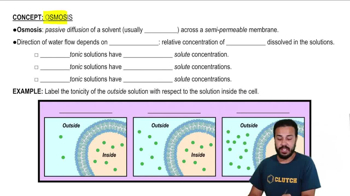
Osmosis is the movement of water across a semipermeable membrane from low to high solute concentration. Tonicity describes the relative solute concentration of the environment compared to the cell, influencing water movement and cell volume changes in isotonic, hypertonic, and hypotonic solutions.
Recommended video:

Effects of Different Tonic Environments on Cells

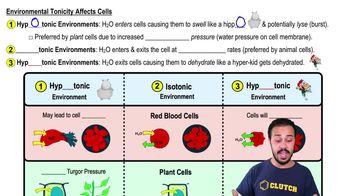
In isotonic solutions, water movement is balanced, so cells remain stable. In hypertonic solutions, water leaves the cell causing shrinkage (plasmolysis). In hypotonic solutions, water enters the cell, which can cause swelling and bursting if the cell wall is damaged and cannot resist osmotic pressure.
Recommended video:
Guided course
10:08
Environmental Tonicity Affects Cells
Related Practice
Textbook Question

Prokaryotic flagella are made of a protein called _________________.

1
views
Textbook Question

Which of the following characteristics regarding prokaryotic ribosomes supports the endosymbiotic theory?

a. Prokaryotic ribosomes are 80S just like eukaryotic ribosomes.

b. Prokaryotic ribosomes are 70S just like mitochondrial ribosomes.

c. Prokaryotic ribosomes make proteins in a similar manner to eukaryotic ribosomes.

d. Prokaryotic ribosomes have two subunits like eukaryotic ribosomes.

e. Prokaryotic ribosomes are intracellular structures like eukaryotic ribosomes.

Textbook Question

Which of the following are true regarding osmosis? Select all that apply.

a. It is driven by differences in solute concentration.

b. It is the same as simple diffusion except it involves water.

c. It involves a selectively permeable membrane.

d. It requires energy to occur.

e. It requires specific channels.

f. Water moves from areas of high solute to areas of low solute.

g. Salt moves from high-water to low-water areas.

h. Water moves from areas of low solute to areas of high solute.

1
views
Textbook Question

Complete the Venn diagram that compares and contrasts Gram-positive and Gram-negative bacteria.

1
views
Textbook Question

Certain bacteria can form endospores in order to __________________.

a. Reproduce

b. Survive harsh conditions

c. Cause recurrent infections

d. Adhere to host tissues

e. Avoid the immune system of a host

2
views
Textbook Question

Complete the table by answering yes or no for each question.

2
views