Ch. 3 - Introduction to Prokaryotic Cells
Norman-McKay- Microbiology: Basic and Clinical Principles 2nd Edition
Norman-McKay2nd EditionMicrobiology: Basic and Clinical PrinciplesISBN: 9780137661619Not the one you use?Change textbook
Chapter 3, Problem 11

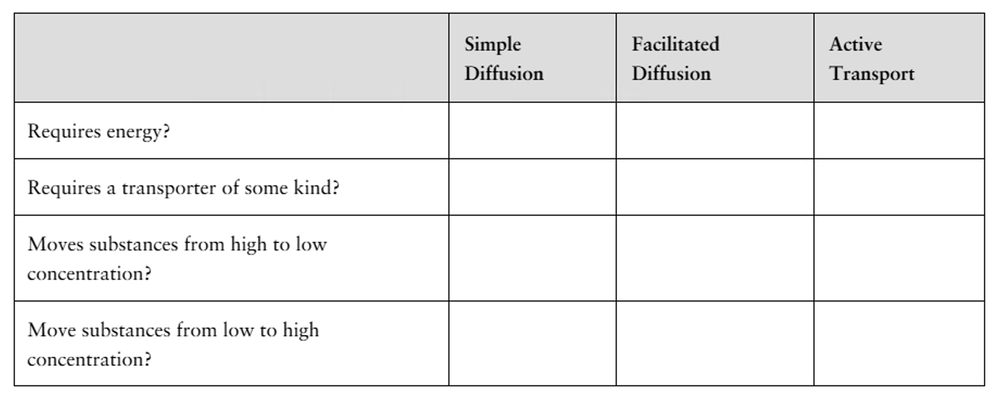
Complete the table by answering yes or no for each question.
Table with questions about energy use, transporters, and concentration movement for three types of cellular transport.

Verified step by step guidance
1
Since the problem references an image and a table that are not provided, start by carefully examining the image and the table to understand what information is being asked for each question.
Identify the criteria or characteristics in the image that correspond to each question in the table. For example, if the questions relate to the presence of certain microbial structures or behaviors, look for those specific features in the image.
For each question, determine whether the feature or condition described is present (answer 'yes') or absent (answer 'no') based on your observations from the image.
Double-check your answers by cross-referencing with your microbiology knowledge about the organisms or processes depicted in the image to ensure accuracy.
Fill in the table with 'yes' or 'no' for each question accordingly, making sure your answers are consistent with both the image evidence and microbiological principles.

Verified video answer for a similar problem:

This video solution was recommended by our tutors as helpful for the problem above.
Video duration:
2m
Was this helpful?

Key Concepts

Here are the essential concepts you must grasp in order to answer the question correctly.

Interpreting Microbiological Data Tables

Understanding how to read and interpret data tables is essential in microbiology. This involves recognizing the parameters measured, such as growth presence, biochemical test results, or antibiotic sensitivity, and accurately translating these into yes/no answers based on the data provided.
Recommended video:
Guided course
07:27
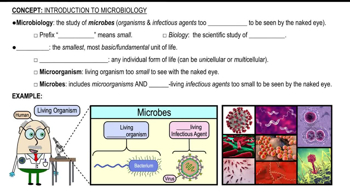
Introduction to Microbiology

Microbial Identification Tests

Microbial identification relies on various biochemical and physiological tests that indicate the presence or absence of specific traits. Knowing common tests, such as catalase, oxidase, or fermentation assays, helps in determining the correct yes/no responses in identification tables.
Recommended video:
Guided course
06:59
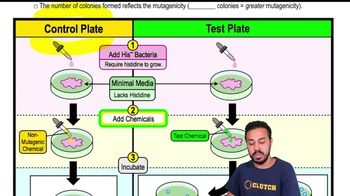
The Ames Test

Binary Classification in Microbiology

Many microbiological assessments use binary outcomes (yes/no) to simplify complex data. Understanding how to classify results into positive or negative categories is crucial for completing tables accurately and making informed conclusions about microbial characteristics.
Recommended video:
Guided course
02:16
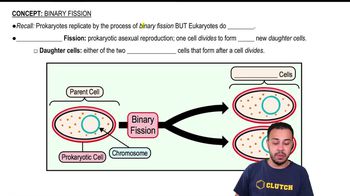
Binary Fission