Ch. 18 - Nervous System Infections
Norman-McKay- Microbiology: Basic and Clinical Principles 2nd Edition
Norman-McKay2nd EditionMicrobiology: Basic and Clinical PrinciplesISBN: 9780137661619Not the one you use?Change textbook
Chapter 18, Problem 9

A patient who has just immigrated to the United States after serving in the Iraqi army is displaying a bruiselike rash, headache, and sensitivity to light. The doctor will immediately recommend administration of
a. ceftriaxone.
b. penicillin.
c. gentamycin.
d. rifampicin.

Verified step by step guidance
1
Step 1: Identify the clinical presentation and possible diagnosis. The patient has a bruiselike rash, headache, and photophobia (sensitivity to light), which are classic signs of meningitis, particularly meningococcal meningitis caused by Neisseria meningitidis.
Step 2: Understand the urgency of treatment. Meningococcal meningitis is a medical emergency requiring immediate antibiotic therapy to prevent severe complications or death.
Step 3: Review the antibiotic options. Ceftriaxone and penicillin are commonly used to treat bacterial meningitis. Gentamycin is generally used for gram-negative infections but not first-line for meningitis. Rifampicin is used mainly for prophylaxis against meningococcal disease, not for treatment.
Step 4: Consider the recommended first-line treatment for suspected meningococcal meningitis. Ceftriaxone is often preferred due to its excellent penetration into the cerebrospinal fluid and broad coverage against Neisseria meningitidis.
Step 5: Conclude that the doctor will most likely recommend administration of ceftriaxone immediately to treat the infection effectively.

Verified video answer for a similar problem:

This video solution was recommended by our tutors as helpful for the problem above.
Video duration:
1m
Was this helpful?

Key Concepts

Here are the essential concepts you must grasp in order to answer the question correctly.

Meningitis and Its Symptoms

Meningitis is an inflammation of the protective membranes covering the brain and spinal cord, often caused by bacterial infection. Common symptoms include headache, sensitivity to light (photophobia), and a characteristic rash. Recognizing these signs is crucial for prompt diagnosis and treatment.
Recommended video:
Guided course
02:10
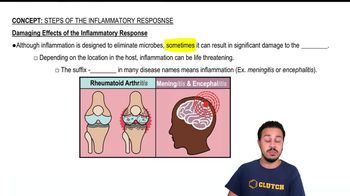
Damaging Effects of the Inflammatory Response

Empiric Antibiotic Treatment for Bacterial Meningitis

Empiric treatment refers to starting antibiotics before the exact pathogen is identified, based on the most likely cause. Ceftriaxone is a broad-spectrum cephalosporin commonly used as first-line therapy for bacterial meningitis due to its effectiveness against common pathogens and good central nervous system penetration.
Recommended video:
Guided course
03:49
Mechanism of Natural Transformation

Role of Antibiotics Listed in the Question

Ceftriaxone is effective against many meningitis-causing bacteria; penicillin targets specific bacteria but may be less broad; gentamycin is mainly used for gram-negative infections and not first-line for meningitis; rifampicin is often used for prophylaxis, not initial treatment. Understanding their uses helps select the correct immediate therapy.
Recommended video:
Guided course
03:43
Normal Microbiota
Related Practice
Textbook Question

During a lumbar puncture procedure, the nurse observed that the patient’s CSF pressure was high. However, when the analysis of the CSF sample comes back, the glucose levels are normal. The nurse would most likely suspect:

a. arboviral meningitis.

b. Neisseria meningitidis.

c. Listeria monocytogenes.

d. poliovirus.

Textbook Question

An HIV/AIDS patient is presenting with flulike symptoms, headache, fever, and disorientation. The MOST important piece of information a nurse must obtain for the patient is his or her

a. travel history, in and outside the United States.

b. diet for the last 3 days.

c. exposure to lakes or streams.

d. exposure to bats.

Textbook Question

Which of the following symptoms would be most informative in terms of ruling out a prion disease as a differential diagnosis?

a. Nuchal rigidity

b. Hallucinations

c. Fatigue

d. Headache

3
views
Textbook Question

A vaccine against Listeria monocytogenes is a challenge to develop because

a. very few people get Listeria meningitis.

b. the antibody-mediated immune response is not effective against L. monocytogenes.

c. better prevention approaches exist, such as food preparation precautions.

d. vaccinations are not used for foodborne illness.

1
views
Textbook Question

The protists Trypanosoma brucei, Naegleria fowleri, and Toxoplasma gondii

a. invade host cells to cause cellular damage.

b. are only infective in the flagellated form.

c. have a nucleus and are eukaryotic.

d. have all of the above characteristics.

1
views
Textbook Question

Tetanospasmin and botulinum toxins affect muscles by

a. blocking the action potential traveling from the CNS to the PNS.

b. allowing the bacteria to enter neurons.

c. blocking the relaxation or contraction of the muscles.

d. damaging the axon itself.

1
views