Ch. 15 - Antimicrobial Drugs
Norman-McKay- Microbiology: Basic and Clinical Principles 2nd Edition
Norman-McKay2nd EditionMicrobiology: Basic and Clinical PrinciplesISBN: 9780137661619Not the one you use?Change textbook
Chapter 15, Problem 3

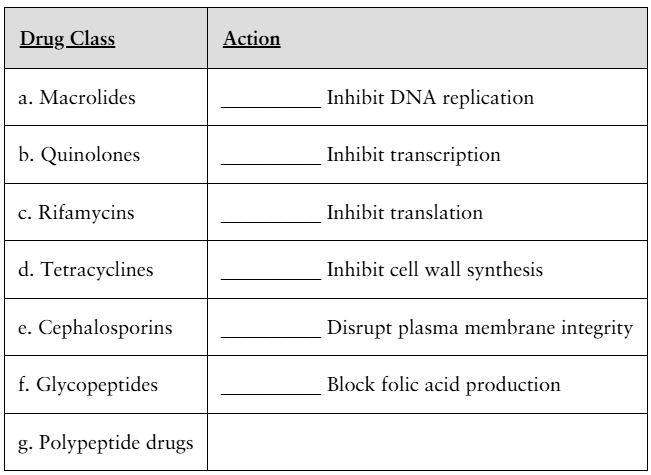
Match the antimicrobial drug class to its action. You may assign more than one drug class to a given action and some actions may not be applicable.
Table listing antimicrobial drug classes with blank lines to match each to their specific action against microbes.

Verified step by step guidance
1
Step 1: Understand the mechanism of each drug class. For example, Quinolones inhibit DNA replication by targeting bacterial DNA gyrase and topoisomerase IV, so they are associated with inhibiting DNA replication.
Step 2: Match the drug classes to their known actions based on their mechanisms. For instance, Rifamycins inhibit transcription by binding to bacterial RNA polymerase, so they inhibit transcription.
Step 3: Identify which drug classes inhibit translation. Macrolides and Tetracyclines both inhibit bacterial protein synthesis by targeting the ribosome, so they inhibit translation.
Step 4: Recognize that Cephalosporins and Glycopeptides inhibit cell wall synthesis. Cephalosporins disrupt peptidoglycan cross-linking, and Glycopeptides block cell wall precursor synthesis, so both inhibit cell wall synthesis.
Step 5: Understand that Polypeptide drugs disrupt plasma membrane integrity by interacting with membrane components, so they are associated with disrupting plasma membrane integrity. Also, drugs like Sulfonamides (not listed here) block folic acid production, but among the given classes, Glycopeptides do not block folic acid production, so this action may not apply to the listed classes.

Verified video answer for a similar problem:

This video solution was recommended by our tutors as helpful for the problem above.
Video duration:
3m
Was this helpful?

Key Concepts

Here are the essential concepts you must grasp in order to answer the question correctly.

Mechanism of Action of Antimicrobial Drugs

Antimicrobial drugs target specific processes essential for microbial survival, such as DNA replication, transcription, translation, cell wall synthesis, membrane integrity, and folic acid production. Understanding these mechanisms helps in matching drug classes to their specific actions and predicting their effects on microbes.
Recommended video:
Guided course
02:43
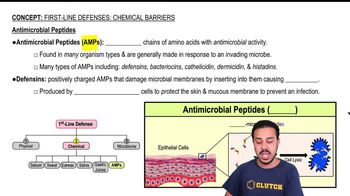
Antimicrobial Peptides

Classes of Antimicrobial Drugs and Their Targets

Different drug classes act on distinct microbial targets: Quinolones inhibit DNA replication; Rifamycins inhibit transcription; Macrolides and Tetracyclines inhibit translation; Cephalosporins and Glycopeptides inhibit cell wall synthesis; Polypeptide drugs disrupt plasma membrane integrity or other functions. Recognizing these associations is key to correctly matching drugs to their actions.
Recommended video:
Guided course
04:43
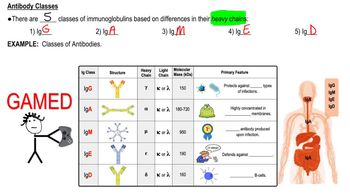
Classes of Antibodies

Selective Toxicity in Antimicrobial Therapy

Selective toxicity refers to the ability of antimicrobial drugs to target microbial cells without harming host cells by exploiting differences like cell wall presence or unique enzymes. This principle underlies why certain drugs inhibit bacterial cell wall synthesis or folic acid production, processes absent or different in human cells.
Recommended video:
Guided course
03:27
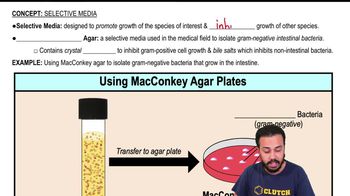
Selective Media