Ch. 15 - Antimicrobial Drugs
Norman-McKay- Microbiology: Basic and Clinical Principles 2nd Edition
Norman-McKay2nd EditionMicrobiology: Basic and Clinical PrinciplesISBN: 9780137661619Not the one you use?Change textbook
Chapter 15, Problem 13

Acquired antibiotic resistance can include all of the following except:
a. Altering an enzyme that a given drug may target
b. Making endospores
c. Altering a point of entry for a drug
d. Making enzymes that inactivate a drug
e. Increasing the number of efflux pumps that are active in a cell

Verified step by step guidance
1
Step 1: Understand the concept of acquired antibiotic resistance, which refers to the mechanisms bacteria develop to survive exposure to antibiotics that would normally inhibit or kill them.
Step 2: Review each option to determine if it represents a known mechanism of acquired antibiotic resistance:
- Option a: Altering an enzyme that a drug targets is a common resistance mechanism, as it prevents the drug from binding effectively.
- Option b: Making endospores is a survival strategy but not a mechanism of antibiotic resistance; endospores allow bacteria to survive harsh conditions but do not directly confer resistance to antibiotics.
- Option c: Altering a point of entry for a drug (such as changing porin channels) reduces drug uptake and is a recognized resistance mechanism.
- Option d: Producing enzymes that inactivate a drug (like beta-lactamases) is a classic resistance strategy.
- Option e: Increasing efflux pumps to actively remove antibiotics from the cell is another well-known resistance mechanism.
Step 3: Conclude that the exception is the option that does not describe an acquired antibiotic resistance mechanism, which is making endospores.

Verified video answer for a similar problem:

This video solution was recommended by our tutors as helpful for the problem above.
Video duration:
2m
Was this helpful?

Key Concepts

Here are the essential concepts you must grasp in order to answer the question correctly.

Mechanisms of Acquired Antibiotic Resistance

Acquired antibiotic resistance occurs when bacteria develop new traits that reduce drug effectiveness. Common mechanisms include modifying drug targets, producing enzymes that degrade antibiotics, altering drug entry points, and increasing efflux pumps to expel drugs. These adaptations help bacteria survive antibiotic treatment.
Recommended video:
Guided course
03:49
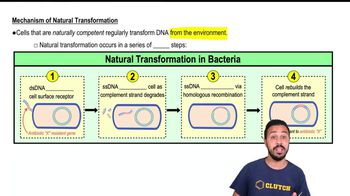
Mechanism of Natural Transformation

Role of Endospores in Bacterial Survival

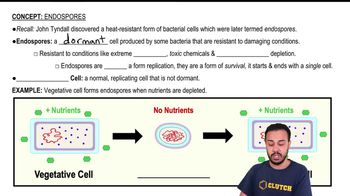
Endospores are dormant, highly resistant structures formed by some bacteria to survive harsh conditions. While they protect bacteria from environmental stress, endospores do not directly confer antibiotic resistance by altering drug action or metabolism, making spore formation unrelated to acquired antibiotic resistance mechanisms.
Recommended video:

Efflux Pumps and Drug Entry Alterations

Efflux pumps are protein transporters that actively expel antibiotics from bacterial cells, reducing intracellular drug concentration. Altering drug entry points, such as modifying porin channels, limits antibiotic uptake. Both strategies decrease drug effectiveness and are common acquired resistance mechanisms.
Recommended video:
Guided course
04:29
Animal Viruses: 2. Entry & Uncoating in the Host Cell
Related Practice
Textbook Question

Assume a bacterium makes beta-lactamase. Could you still use a glycopeptide drug to treat an infection caused by this bacterium? Explain your reasoning.

1
views
Textbook Question

Mark the following as true or false, and then correct the false statements so they are true.

a. Human cells make drug efflux pumps.

b. The minimum bactericidal concentration is the minimum concentration of the drug that kills at least 50 percent of the bacteria present.

c. The E-test can reveal if a drug is bactericidal or bacteriostatic.

d. A drug that is bactericidal at one dose may be bacteriostatic at another dose.

e. The antifolate combination therapy trimethoprim-sulfamethoxazole may be used to treat protozoan infections.

2
views
Textbook Question

Why is it challenging to obtain selectively toxic drugs against fungi, protozoans, and viruses?

1
views
Textbook Question

Choose the false statement(s). Select all that apply.

a. Antifungal drugs may target cholesterol in fungal cell membranes.

b. Azole and polyene drugs promote cell lysis by impacting fungal cell plasma membranes.

c. Echinocandin drugs inhibit fungal cell wall synthesis.

d. Antifungal drugs may target DNA replication.

e. Antifungal drugs may target protein synthesis.

2
views
Textbook Question

If a gene encoding a bacterial transpeptidase enzyme undergoes mutation, which of the following antimicrobials may no longer be effective against the mutated bacterium?

a. Macrolides

b. Polypeptide drugs

c. Tetracyclines

d. Penicillins

e. Quinolones

6
views
Textbook Question

Assume a clinical sample yields a strain of S. aureus containing a plasmid that encodes two antimicrobial-resistance genes. How did the bacterium most likely acquire these new resistance genes?

a. The strain was intrinsically resistant.

b. The strain obtained the genes through horizontal gene transfer.

c. The strain acquired the genes by a random mutation.

d. The strain picked up the genes by an efflux pump.

e. The strain acquired the genes through cell division events.