Ch. 11 - Innate Immunity
Norman-McKay- Microbiology: Basic and Clinical Principles 2nd Edition
Norman-McKay2nd EditionMicrobiology: Basic and Clinical PrinciplesISBN: 9780137661619Not the one you use?Change textbook
Chapter 11, Problem 19

Which of the following shows a correct chronological order of events in inflammation?
a. Neutrophil recruitment, macrophage recruitment, vascular changes, resolution
b. Vascular changes, resolution, neutrophil recruitment, macrophage recruitment
c. Vascular changes, macrophage recruitment, neutrophil recruitment, resolution
d. Vascular changes, macrophage recruitment, resolution, neutrophil recruitment
e. Vascular changes, neutrophil recruitment, macrophage recruitment, resolution

Verified step by step guidance
1
Step 1: Understand the process of inflammation, which typically begins with vascular changes such as vasodilation and increased vascular permeability to allow immune cells to access the affected tissue.
Step 2: Recognize that neutrophils are usually the first immune cells recruited to the site of inflammation, arriving quickly to phagocytose pathogens and debris.
Step 3: After neutrophils, macrophages are recruited to the site; they help in clearing dead cells and orchestrating tissue repair.
Step 4: Following the immune cell recruitment and activity, the inflammation process moves towards resolution, where tissue repair and the return to homeostasis occur.
Step 5: Based on this sequence, the correct chronological order is: vascular changes, neutrophil recruitment, macrophage recruitment, and resolution.

Verified video answer for a similar problem:

This video solution was recommended by our tutors as helpful for the problem above.
Video duration:
3m
Was this helpful?

Key Concepts

Here are the essential concepts you must grasp in order to answer the question correctly.

Vascular Changes in Inflammation

Vascular changes are the initial events in inflammation, involving vasodilation and increased permeability of blood vessels. These changes allow immune cells and plasma proteins to exit the bloodstream and enter the affected tissue, setting the stage for the immune response.
Recommended video:
Guided course
03:09
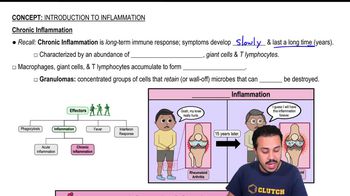
Chronic Inflammation

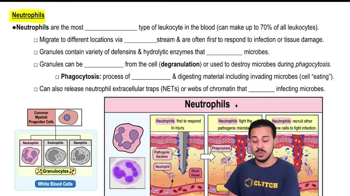
Neutrophil and Macrophage Recruitment

Neutrophils are the first immune cells recruited to the site of inflammation, arriving quickly to phagocytose pathogens. Macrophages arrive later to clear debris, dead cells, and orchestrate tissue repair, marking a transition from acute to resolution phases.
Recommended video:

Resolution of Inflammation

Resolution is the final phase where inflammation subsides, damaged tissue is repaired, and homeostasis is restored. This phase involves the clearance of immune cells and the release of anti-inflammatory mediators to prevent chronic inflammation.
Recommended video:
Guided course
03:09
Chronic Inflammation