Ch. 11 - Innate Immunity
Norman-McKay- Microbiology: Basic and Clinical Principles 2nd Edition
Norman-McKay2nd EditionMicrobiology: Basic and Clinical PrinciplesISBN: 9780137661619Not the one you use?Change textbook
Chapter 11, Problem 21

Which of the following is a chemical defense found in tears? Select all that apply.
a. Water
b. Lysozyme
c. Antimicrobial peptides
d. Neutrophils

Verified step by step guidance
1
Understand that tears provide a chemical defense as part of the body's innate immune system to protect the eyes from microbial infection.
Identify the components listed that are chemical substances versus cellular components. Chemical defenses are molecules, while cells like neutrophils are part of the cellular immune response.
Recognize that water (option a) is primarily a physical medium and does not have antimicrobial properties by itself, so it is not considered a chemical defense.
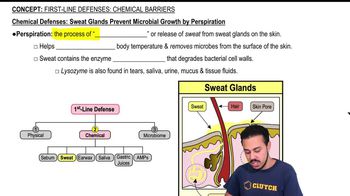
Recall that lysozyme (option b) is an enzyme present in tears that breaks down bacterial cell walls, making it a key chemical defense.
Know that antimicrobial peptides (option c) are small proteins that can disrupt microbial membranes and are also part of the chemical defenses in tears, whereas neutrophils (option d) are immune cells and not a chemical defense.

Verified video answer for a similar problem:

This video solution was recommended by our tutors as helpful for the problem above.
Video duration:
3m
Was this helpful?

Key Concepts

Here are the essential concepts you must grasp in order to answer the question correctly.

Chemical Defenses in Tears

Tears contain various chemical substances that protect the eyes from microbial infection. These include enzymes and peptides that can directly kill or inhibit the growth of pathogens, forming part of the innate immune system.
Recommended video:
Guided course
02:04
Chemical Defenses: Sweat Glands Prevent Microbial Growth by Perspiration

Lysozyme

Lysozyme is an enzyme abundant in tears that breaks down the peptidoglycan layer of bacterial cell walls, especially in Gram-positive bacteria, leading to their destruction. It is a key antimicrobial agent in the chemical defense of mucosal surfaces.
Recommended video:
Guided course
02:04
Chemical Defenses: Sweat Glands Prevent Microbial Growth by Perspiration

Antimicrobial Peptides

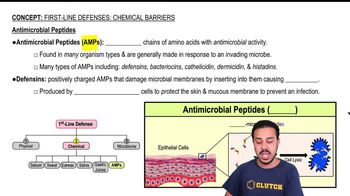
Antimicrobial peptides are small proteins found in tears that disrupt microbial membranes, causing cell death. They provide broad-spectrum defense against bacteria, fungi, and viruses, complementing other chemical defenses like lysozyme.
Recommended video:
Guided course
02:43
Antimicrobial Peptides