Ch. 1 - Introduction to Microbiology
Norman-McKay- Microbiology: Basic and Clinical Principles 2nd Edition
Norman-McKay2nd EditionMicrobiology: Basic and Clinical PrinciplesISBN: 9780137661619Not the one you use?Change textbook
Chapter 1, Problem 5

Assume you are asked to view and draw all samples at a final magnification of 1000x. If the ocular lens is 10x, what objective lens should be in place as you draft your drawings?

Verified step by step guidance
1
Understand that the total magnification of a microscope is the product of the magnification of the ocular lens and the objective lens. This means: \(\text{Total Magnification} = \text{Ocular Magnification} \times \text{Objective Magnification}\).
Identify the given values: the total magnification desired is 1000x, and the ocular lens magnification is 10x.
Set up the equation using the known values: \(1000 = 10 \times \text{Objective Magnification}\).
Solve for the objective magnification by dividing both sides of the equation by 10: \(\text{Objective Magnification} = \frac{1000}{10}\).
Interpret the result to determine which objective lens (e.g., 40x, 100x) corresponds to the calculated magnification and select that lens for your drawings.

Verified video answer for a similar problem:

This video solution was recommended by our tutors as helpful for the problem above.
Video duration:
1m
Was this helpful?

Key Concepts

Here are the essential concepts you must grasp in order to answer the question correctly.

Magnification in Microscopy

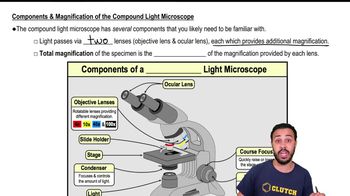
Magnification is the process of enlarging the appearance of an object using lenses. In light microscopy, total magnification is the product of the ocular lens magnification and the objective lens magnification. Understanding how these combine is essential to determine the correct lens needed for a desired final magnification.
Recommended video:
Guided course
06:15
Components & Magnification of the Compound Light Microscope

Ocular Lens (Eyepiece) Function

The ocular lens, or eyepiece, is the lens closest to the observer's eye and typically provides a fixed magnification, often 10x. It further enlarges the image formed by the objective lens, contributing to the total magnification seen through the microscope.
Recommended video:
Guided course
06:04
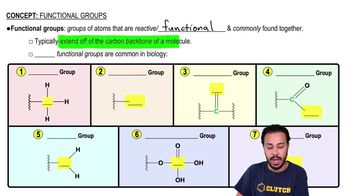
Functional Groups

Objective Lens Selection

The objective lens is the primary lens responsible for initial magnification and resolution of the specimen. To achieve a specific total magnification, the objective lens magnification must be chosen so that when multiplied by the ocular lens magnification, it equals the desired final magnification.
Recommended video:
Guided course
03:27
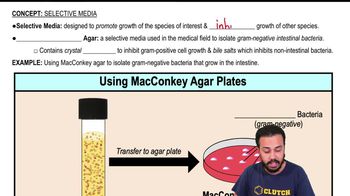
Selective Media
Related Practice
Textbook Question

Indicate the true statements and then correct the false statements so that they are true.

a. The Gram stain is a simple stain.

b. Simple stains reveal information about size, shape, and arrangement.

c. Bright field microscopy requires a stained sample.

d. Dark field microscopy requires a stained sample.

e. The acid-fast stain detects peptidoglycan in the cell walls of certain bacteria.

f. Gram-positive bacteria have a thin peptidoglycan layer in the cell wall.

7
views
Textbook Question

Identify the following statements as observations or conclusions.

a. The solution turned red.

b. The bacterium is a rod shape.

c. The cell died due to lack of nutrients.

d. The bacterium is E. coli.

e. The cell is Gram-positive.

f. The bacterium is a pathogen.

g. There are small green structures present upon performing the endospore stain.

h. The solution remained clear after 10 hours of incubation.

i. Fermentation occurred.

j. Life comes from life.

6
views
1
rank
Textbook Question

Assume that you isolated a unicellular, non-nucleated cell from a deep-sea vent. Select the statement that is least likely regarding the cell you found.

a. The cell is a prokaryote.

b. The cell is a fungus or yeast.

c. The cell is an archaea.

d. The cell is not a pathogen.

e. The cell is in Domain Archaea.

1
views
Textbook Question

Match the following people to their scientific/medical contribution:

Note: Choices may be used more than once or not at all.

5
views
Textbook Question

Select the most accurate statement.

a. The Gram stain is a simple stain.

b. Bacterial endospores appear green from the acid-fast stain.

c. The acid-fast stain is used to detect bacteria that have a capsule.

d. Bacterial flagella can only be seen with electron microscopes.

e. The mordant in the Gram stain is iodine.

1
views
Textbook Question

Fill in the blanks: Bacteria are ___________________ cells in the domain ___________________. In contrast, the domain ___________________ includes unicellular and multicellular organisms that are made of ___________________ cells, or cells that have a nucleus and membrane-bound organelles.