Ch. 8 - Recombinant DNA Technology
Bauman - Microbiology with Diseases by Taxonomy 6th Edition
Bauman6th EditionMicrobiology with Diseases by TaxonomyISBN: 9780134832302Not the one you use?Change textbook
Chapter 8, Problem 1

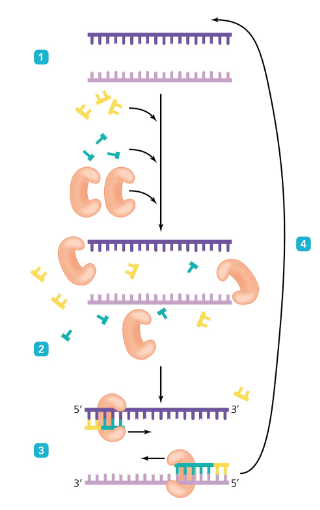
Label the reagents and steps of PCR on the following figure. Indicate the temperature of the reaction at each numbered step.
Diagram illustrating the three main PCR steps with reagents and reaction temperatures labeled at each stage.

Verified step by step guidance
1
Step 1 corresponds to the denaturation phase of PCR. In this step, the double-stranded DNA is heated to a high temperature (usually around 94-98°C) to separate it into two single strands. This is essential to allow primers to access the DNA template.
Step 2 is the annealing phase. Here, the temperature is lowered (typically between 50-65°C) to allow primers to bind or anneal to their complementary sequences on the single-stranded DNA templates. The exact temperature depends on the primer sequences and their melting temperatures.
Step 3 represents the extension (or elongation) phase. The temperature is raised to the optimal working temperature of the DNA polymerase enzyme (commonly around 72°C). During this step, the DNA polymerase synthesizes new DNA strands by adding nucleotides complementary to the template strand, starting from the primers.
Step 4 indicates the cycle repetition. After extension, the reaction mixture is again heated to denature the newly formed double-stranded DNA, and the cycle repeats multiple times (usually 25-35 cycles) to exponentially amplify the target DNA sequence.
The reagents involved in these steps include the template DNA (purple strands), primers (yellow and teal short sequences), DNA polymerase enzyme (orange shapes), and nucleotides (not explicitly shown but necessary for extension). Each step's temperature is critical to ensure specificity and efficiency of the PCR.

Verified video answer for a similar problem:

This video solution was recommended by our tutors as helpful for the problem above.
Video duration:
2m
Was this helpful?

Key Concepts

Here are the essential concepts you must grasp in order to answer the question correctly.

PCR Denaturation Step

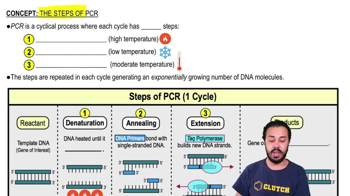
Denaturation is the first step in PCR where the double-stranded DNA is heated to around 94-98°C to separate it into two single strands. This high temperature breaks the hydrogen bonds between complementary bases, allowing the strands to be accessible for primer binding.
Recommended video:
Guided course
04:39
The Steps of PCR

Annealing Step in PCR

During annealing, the reaction temperature is lowered to 50-65°C to allow primers to bind or anneal to their complementary sequences on the single-stranded DNA templates. The exact temperature depends on the primer sequences and is critical for specificity.
Recommended video:
Guided course
04:39
The Steps of PCR

Extension (Elongation) Step

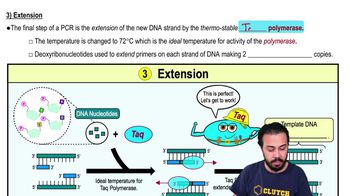
In the extension step, the temperature is raised to about 72°C, optimal for the DNA polymerase enzyme to synthesize new DNA strands by adding nucleotides complementary to the template strand. This step results in the formation of new double-stranded DNA molecules.
Recommended video: