Ch. 8 - Recombinant DNA Technology
Bauman - Microbiology with Diseases by Taxonomy 6th Edition
Bauman6th EditionMicrobiology with Diseases by TaxonomyISBN: 9780134832302Not the one you use?Change textbook
Chapter 8, Problem 10

A DNA microarray consists of __________ .


a. a series of clones containing the entire genome of a microbe
b. recombinant microbial cells
c. restriction enzyme fragments of DNA molecules
d. single-stranded DNA localized on a substrate

Verified step by step guidance
1
Understand what a DNA microarray is: it is a tool used to detect the presence of specific DNA sequences by hybridization.
Recall that DNA microarrays consist of many spots, each containing single-stranded DNA sequences fixed on a solid surface, such as a glass slide or silicon chip.
Each spot on the microarray contains single-stranded DNA probes that can hybridize with complementary DNA or RNA from a sample.
Compare the options given: (a) refers to clones of entire genomes, (b) refers to recombinant cells, (c) refers to restriction fragments, and (d) refers to single-stranded DNA localized on a substrate.
Conclude that the correct description of a DNA microarray is (d) single-stranded DNA localized on a substrate, because this allows hybridization and detection of target sequences.

Verified video answer for a similar problem:

This video solution was recommended by our tutors as helpful for the problem above.
Video duration:
3m
Was this helpful?

Key Concepts

Here are the essential concepts you must grasp in order to answer the question correctly.

DNA Microarray Structure

A DNA microarray is a collection of single-stranded DNA probes fixed on a solid surface, such as a glass slide. These probes represent specific DNA sequences and are used to detect complementary DNA or RNA in a sample through hybridization.
Recommended video:
Guided course
04:41
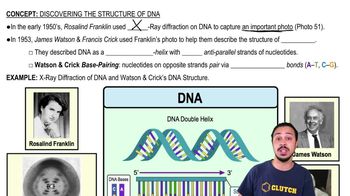
Discovering the Structure of DNA

Single-Stranded DNA Probes

The probes on a microarray are single-stranded DNA molecules that can specifically bind to complementary sequences in a sample. This specificity allows researchers to analyze gene expression or detect genetic variations.
Recommended video:
Guided course
05:15
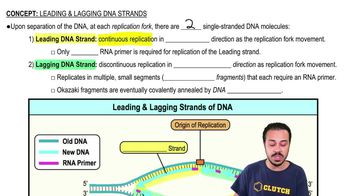
Leading & Lagging DNA Strands

Hybridization Principle

Hybridization is the process where single-stranded DNA or RNA molecules anneal to complementary DNA probes on the microarray. This binding is the basis for detecting and quantifying specific nucleic acid sequences in the sample.
Recommended video:
Guided course
04:43
Laws of Thermodynamics