How does oxidation of a molecule occur without oxygen?
Ch. 5 - Microbial Metabolism
Bauman6th EditionMicrobiology with Diseases by TaxonomyISBN: 9780134832302Not the one you use?Change textbook
Chapter 5, Problem 7
For the phrase given below, indicate the type of metabolism referred to, using the following choices:
a. Anabolism only
b. Both anabolism and catabolism (amphibolic)
c. Catabolism only
Includes metabolism
Verified step by step guidance1
Step 1: Understand the definitions of the key terms: Anabolism refers to the set of metabolic pathways that construct molecules from smaller units, requiring energy input. Catabolism refers to the breakdown of molecules into smaller units, releasing energy. Amphibolic metabolism involves pathways that function in both anabolism and catabolism.
Step 2: For each phrase or metabolic process given in questions 1–7, identify whether it involves building molecules (anabolism), breaking down molecules (catabolism), or both processes (amphibolic).
Step 3: Use the following classification to assign the correct type of metabolism: a) anabolism only if the process solely builds complex molecules, b) both anabolism and catabolism (amphibolic) if the process includes pathways that both synthesize and degrade molecules, c) catabolism only if the process solely breaks down molecules to release energy.
Step 4: Carefully analyze the context of each phrase to determine if energy is consumed (anabolism), released (catabolism), or if the pathway serves dual roles (amphibolic).
Step 5: Record your answers for each phrase by matching them to the correct letter choice (a, b, or c) based on your analysis.

Verified video answer for a similar problem:
This video solution was recommended by our tutors as helpful for the problem above.
Video duration:
1mWas this helpful?
Key Concepts
Here are the essential concepts you must grasp in order to answer the question correctly.
Anabolism
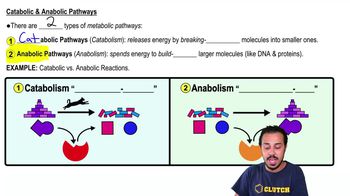
Anabolism refers to the set of metabolic pathways that build complex molecules from simpler ones, requiring energy input. It is essential for cell growth, repair, and synthesis of macromolecules like proteins and nucleic acids.
Recommended video:
Guided course
Catabolic & Anabolic Pathways
Catabolism
Catabolism involves the breakdown of complex molecules into simpler ones, releasing energy stored in chemical bonds. This energy is often captured as ATP, which cells use to power various functions.
Recommended video:
Guided course
Catabolic & Anabolic Pathways
Amphibolic Metabolism
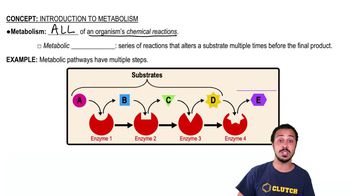
Amphibolic pathways serve dual roles in metabolism, functioning in both anabolism and catabolism. These pathways, such as the citric acid cycle, help cells efficiently manage energy production and biosynthesis.
Recommended video:
Guided course
Introduction to Metabolism
Related Practice
Textbook Question
2
views
Textbook Question
For the phrase given below, indicate the type of metabolism referred to, using the following choices:
a. Anabolism only
b. Both anabolism and catabolism (amphibolic)
c. Catabolism only
Includes hydrolytic reactions
1
views
Textbook Question
List at least four groups of microorganisms that are photosynthetic.
Textbook Question
Anaerobic respiration typically uses (organic/inorganic)________ molecules as final electron acceptors.
8
views
Textbook Question
Complete the following chart:
The main coenzymes that carry electrons in catabolic pathways are _______ and ________.
1
views
Textbook Question
Facultative anaerobes can live under either aerobic or anaerobic conditions. What metabolic pathways allow these organisms to continue to harvest energy from sugar molecules in the absence of oxygen?
1
views