Ch. 24 - Pathogenic DNA Viruses
Bauman - Microbiology with Diseases by Taxonomy 6th Edition
Bauman6th EditionMicrobiology with Diseases by TaxonomyISBN: 9780134832302Not the one you use?Change textbook
Chapter 24, Problem 1

The Smith family seems to get fever blisters regularly. Suggest an explanation for this observation.

Verified step by step guidance
1
Understand that fever blisters, also known as cold sores, are caused by the herpes simplex virus (HSV), most commonly HSV type 1.
Recognize that after the initial infection, HSV remains latent in the nerve cells and can reactivate periodically, causing recurrent fever blisters.
Consider that the Smith family members may have been exposed to the virus and carry it in a latent form, which can be triggered by factors such as stress, illness, or immune suppression.
Explain that the regular occurrence of fever blisters in the family suggests that the virus is reactivating frequently, possibly due to shared environmental or genetic factors that influence susceptibility or immune response.
Summarize that the explanation involves the nature of HSV latency and reactivation, which leads to recurrent fever blisters in individuals who carry the virus.

Verified video answer for a similar problem:

This video solution was recommended by our tutors as helpful for the problem above.
Video duration:
2m
Was this helpful?

Key Concepts

Here are the essential concepts you must grasp in order to answer the question correctly.

Herpes Simplex Virus (HSV) Latency and Reactivation

Fever blisters are caused by the herpes simplex virus, which can remain dormant in nerve cells after the initial infection. Periodically, the virus reactivates due to triggers like stress or illness, causing recurrent outbreaks of blisters.
Recommended video:
Guided course
02:33
Introduction to Animal Virus Infections

Immune System Response to Viral Infections

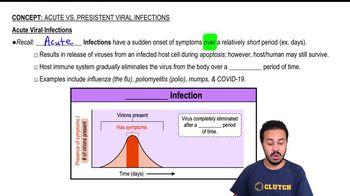
The immune system controls but does not eliminate HSV, allowing the virus to persist lifelong. Variations in immune strength or genetic factors can influence how frequently the virus reactivates and causes symptoms.
Recommended video:
Guided course
03:29
Acute Viral Infections

Transmission and Genetic Susceptibility

HSV is highly contagious and often spreads within families through close contact. Genetic predisposition may affect susceptibility to frequent outbreaks, explaining why some families experience recurrent fever blisters more often.
Recommended video:
Related Practice
Textbook Question

Name the disease shown in each photo.


a. <IMAGE>

b. <IMAGE>

c. <IMAGE>

d. <IMAGE>

e. <IMAGE>

f. <IMAGE>

2
views

Textbook Question

Label the successive stages of skin lesions as exemplified by smallpox.


2
views
Textbook Question

If the envelope of a particular virus were unstable outside the host's body, which of the following statements would you expect to be true concerning this virus?

a. It would be a dsRNA virus.

b. It would be transmitted by intimate contact.

c. Touching a doorknob would easily transmit it.

d. That virus would eventually cease to be a threat to the population.

2
views
Textbook Question

You have been given a large grant to do postgraduate research on live smallpox viruses. Where in the world would you find samples?

2
views
Textbook Question

For which of the following reasons are most animal poxviruses unable to infect humans?

a. Affected animals are not in frequent contact with humans.

b. The human immune system makes it impossible for the foreign viral particles to

reproduce effectively.

c. Attachment to human cells is unlikely.

d. Human cells lack the necessary enzymes for infection.

5
views
Textbook Question

Identify the viral family causing or implicated in each of the following diseases. A viral family name may be used more than once.


1. ____ Chickenpox

2. ____ Smallpox

3. ____ Cowpox

4. ____ Molluscum contagiosum

5. ____ HHV-1 infection

6. ____ Whitlow

7. ____ Shingles

8. ____ Burkitt's lymphoma

9. ____ Infectious mononucleosis

10. ____ Chronic fatigue syndrome

11. ____ Cytomegalovirus infection

12. ____ Genital warts

13. ____ Roseola

14. ____ Plantar warts

15. ____ Progressive multifocal leukoencephalopathy

16. ____ Common cold

17. ____ Hepatitis B

18. ____ Fifth disease


A. Poxviridae

B. Herpesviridae

C. Papillomaviridae

D. Adenoviridae

E. Hepadnaviridae

F. Parvoviridae

G. Polyomaviridae

4
views