

Ch. 20 - Pathogenic Gram-Negative Cocci and Bacilli
Bauman - Microbiology with Diseases by Taxonomy 6th Edition
Bauman6th EditionMicrobiology with Diseases by TaxonomyISBN: 9780134832302Not the one you use?Change textbook
Chapter 20, Problem 2

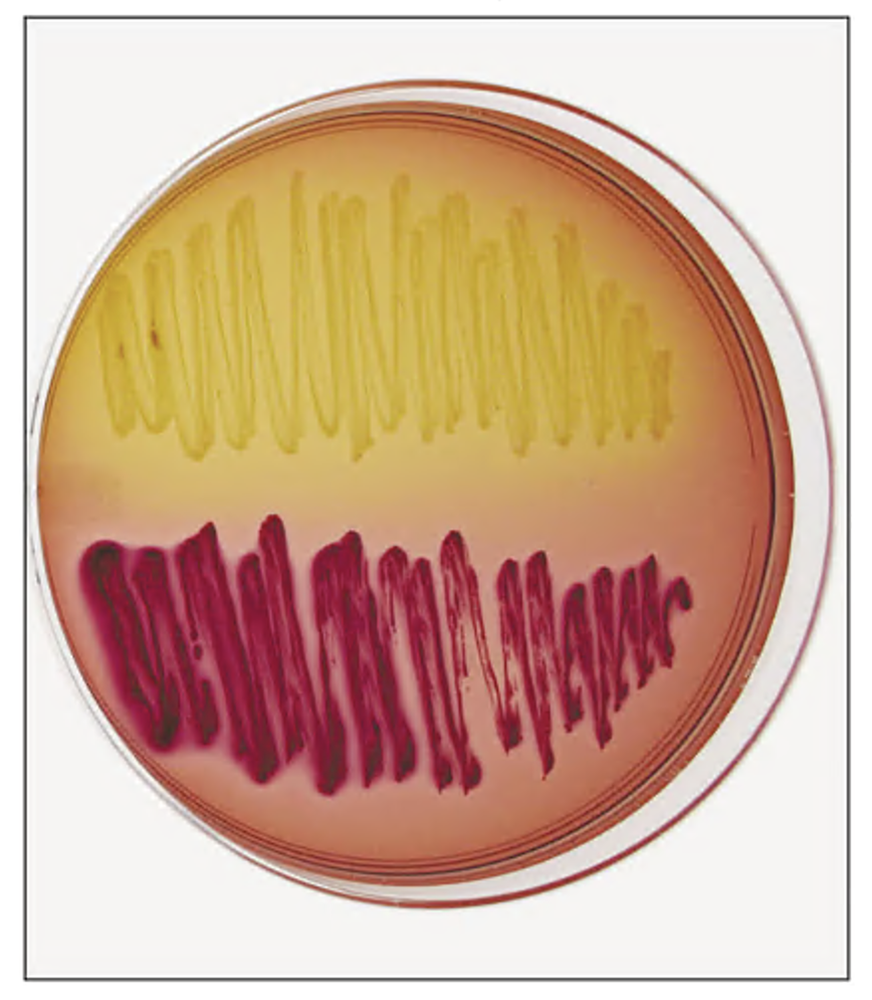
Shown is a MacConkey agar plate. Describe the Gram reaction and lactose fermentation of the two different bacteria shown.
MacConkey agar plate showing two bacteria: one pale yellow (Gram-negative, non-lactose fermenter) and one pink-red (Gram-negative, lactose fermenter).

Verified step by step guidance
1
Step 1: Understand the purpose of MacConkey agar. MacConkey agar is a selective and differential medium used to isolate Gram-negative bacteria and differentiate them based on their ability to ferment lactose.
Step 2: Identify the Gram reaction based on growth. Since MacConkey agar inhibits Gram-positive bacteria, any bacteria growing on the plate are likely Gram-negative.
Step 3: Determine lactose fermentation by observing colony color. Lactose fermenters produce acid, which lowers the pH and causes the colonies to appear pink or red due to the pH indicator neutral red in the medium.
Step 4: For bacteria that do not ferment lactose, colonies remain colorless or take on the natural color of the medium, indicating no acid production.
Step 5: Summarize the observations: bacteria growing with pink/red colonies are Gram-negative lactose fermenters, while those with colorless colonies are Gram-negative non-lactose fermenters.

Verified video answer for a similar problem:

This video solution was recommended by our tutors as helpful for the problem above.
Video duration:
2m
Was this helpful?

Key Concepts

Here are the essential concepts you must grasp in order to answer the question correctly.

MacConkey Agar Composition and Purpose

MacConkey agar is a selective and differential medium designed to isolate Gram-negative bacteria and differentiate them based on lactose fermentation. It contains bile salts and crystal violet to inhibit Gram-positive bacteria, and neutral red as a pH indicator to detect acid production from lactose fermentation.
Recommended video:
Guided course
05:46
Microbiome Composition

Gram Reaction

The Gram reaction classifies bacteria as Gram-positive or Gram-negative based on their cell wall structure and staining properties. Gram-negative bacteria do not retain the crystal violet stain and appear pink or red after counterstaining, while Gram-positive bacteria retain the violet stain and appear purple.
Recommended video:

Lactose Fermentation on MacConkey Agar

Bacteria that ferment lactose produce acid, lowering the pH and causing the neutral red indicator to turn red or pink, resulting in pink colonies. Non-lactose fermenters do not produce acid, so their colonies remain colorless or pale on MacConkey agar.
Recommended video:
Guided course
02:02
Alcohol Fermentation
Related Practice
Textbook Question

Match each bacterium with the disease or manifestations it causes.


1. _____ Escherichia coli

2. _____ Klebsiella pneumoniae

3. _____ Proteus mirabilis

4. _____ Salmonella enterica serotype Typhi

5. _____ Shigella flexneri

6. _____ Yersinia pestis


A. Bubonic plague

B. Typhoid fever

C. Gastroenteritis

D. Kidney stones

E. Pus-filled, bloody stools; cramps; fever; and diarrhea

F. Pneumonia

3
views
Textbook Question

Which of the following bacterial cells is most likely to be virulent?

a. A cell with fimbriae and LOS

b. A cell with a polysaccharide capsule and lipooligosaccharide

c. A cell with fimbriae, lipooligosaccharide, and a polysaccharide capsule

d. A cell with fimbriae but no capsule

2
views
Textbook Question

A physician prescribes fluid replacement to treat a patient with diarrhea. Although tests showed that a pathogenic enteric bacterium was the cause of the intestinal distress, an antimicrobial drug was not prescribed; why not?

4
views
Textbook Question

The only genus of Gram-negative cocci that causes significant disease in humans is

a. Pasteurella

b. Salmonella

c. Klebsiella

d. Neisseria

1
views
Textbook Question

Distinguish among the pathogenicity of coliforms, noncoliforms, and truly pathogenic enteric bacteria.

5
views
Textbook Question

The presence of lipid A in the outer membranes of Gram-negative bacteria.

a. Affects the formation of blood clots in the host

b. Causes these bacteria to be oxidase positive

c. Triggers the secretion of a protease enzyme to cleave IgA in mucus

d. Enables enteric bacteria to ferment glucose anaerobically

1
views