How does nephelometry differ from turbidimetry?
Ch. 17 - Immunization and Immune Testing
Bauman6th EditionMicrobiology with Diseases by TaxonomyISBN: 9780134832302Not the one you use?Change textbook
Chapter 17, Problem 11
Attenuation is:
a. The process of reducing virulence
b. A necessary step in vaccine manufacture
c. A form of variolation
d. Similar to an adjuvant
Verified step by step guidance1
Step 1: Understand the term 'attenuation' in microbiology, which refers to the process by which a pathogen's virulence (ability to cause disease) is reduced.
Step 2: Recognize that attenuation is commonly used in vaccine development to create live attenuated vaccines, where the pathogen is weakened so it can stimulate immunity without causing serious illness.
Step 3: Compare attenuation with other terms: variolation is an older method of inducing immunity by exposure to a less dangerous form of a pathogen, and an adjuvant is a substance that enhances the immune response to an antigen, which is different from attenuation.
Step 4: Conclude that attenuation is specifically the process of reducing virulence and is a necessary step in making certain vaccines, but it is not the same as variolation or an adjuvant.
Step 5: Therefore, the correct understanding is that attenuation is both the process of reducing virulence and a necessary step in vaccine manufacture.

Verified video answer for a similar problem:
This video solution was recommended by our tutors as helpful for the problem above.
Video duration:
2mWas this helpful?
Key Concepts
Here are the essential concepts you must grasp in order to answer the question correctly.
Attenuation
Attenuation refers to the process of reducing the virulence or pathogenicity of a microorganism, making it less harmful while retaining its ability to induce an immune response. This is commonly used in creating live vaccines to safely stimulate immunity.
Vaccine Manufacture
Vaccine manufacture involves producing biological preparations that provide immunity against diseases. Attenuation is a critical step in making live attenuated vaccines, where pathogens are weakened to ensure safety and effectiveness.
Recommended video:
Guided course
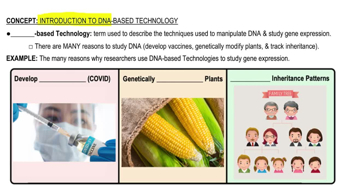
Introduction to DNA-Based Technology
Variolation and Adjuvants
Variolation was an early method of inducing immunity by exposing individuals to material from smallpox lesions, differing from attenuation. Adjuvants are substances added to vaccines to enhance immune response, but they do not reduce virulence like attenuation does.
Related Practice
Textbook Question
4
views
Textbook Question
An antiserum is:
a. An anti-antibody
b. An inactivated vaccine
c. Formed of monoclonal antibodies
d. The liquid portion of blood used for immunization
4
views
Textbook Question
Monoclonal antibodies:
a. Are produced by hybridomas
b. Are secreted by clone cells
c. Can be used for passive immunization
d. All of the above
1
views
Textbook Question
An ELISA uses which of the following reagents?
a. Enzyme-labeled anti-antibody
b. Radioactive anti-antibody
c. Source of complement
d. Enzyme-labeled antigen
2
views
Textbook Question
Which of the following is a good test to detect rabies virus in the brain of a dog?
a. Agglutination
b. Hemagglutination inhibition
c. Virus neutralization
d. Direct fluorescent antibody
2
views
Textbook Question
The study of antibody-antigen interaction in the blood is:
a. Attenuation
b. Agglutination
c. Precipitation
d. Serology
1
views