Ch. 17 - Immunization and Immune Testing
Bauman - Microbiology with Diseases by Taxonomy 6th Edition
Bauman6th EditionMicrobiology with Diseases by TaxonomyISBN: 9780134832302Not the one you use?Change textbook
Chapter 17, Problem 7

A direct fluorescent immunoassay requires which of the following?
a. Heat-inactivated serum
b. Fluorescent serum
c. Immune complexes
d. Antibodies against the antigen

Verified step by step guidance
1
Understand the principle of a direct fluorescent immunoassay (DFA): it uses antibodies that are directly labeled with a fluorescent dye to detect specific antigens in a sample.
Identify the key reagent required in DFA: since the assay detects antigens by binding of fluorescently labeled antibodies, the essential component is antibodies that are conjugated with a fluorescent marker.
Evaluate each option in the context of DFA: (a) Heat-inactivated serum is not specifically required for DFA; (b) Fluorescent serum is not a standard term and does not describe the necessary reagent; (c) Immune complexes are the result of antigen-antibody binding, not a reagent; (d) Antibodies against the antigen are necessary, especially if they are fluorescently labeled.
Conclude that the correct requirement for a direct fluorescent immunoassay is antibodies that specifically recognize the antigen, typically labeled with a fluorescent dye to allow visualization under a fluorescence microscope.
Summarize that the key to DFA is the use of fluorescently labeled antibodies that bind directly to the target antigen, enabling detection.

Verified video answer for a similar problem:

This video solution was recommended by our tutors as helpful for the problem above.
Video duration:
2m
Was this helpful?

Key Concepts

Here are the essential concepts you must grasp in order to answer the question correctly.

Direct Fluorescent Immunoassay (DFA)

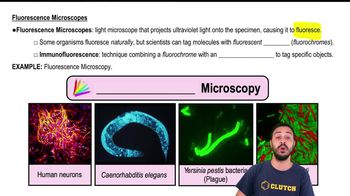
DFA is a diagnostic technique that uses fluorescently labeled antibodies to detect specific antigens in a sample. The antibodies bind directly to the target antigen, allowing visualization under a fluorescence microscope.
Recommended video:
Guided course
02:54
Fluorescence Microscopes

Role of Antibodies in Immunoassays

Antibodies are proteins that specifically recognize and bind to antigens. In DFA, fluorescently tagged antibodies are essential because they provide the specificity and the fluorescent signal needed to identify the presence of the antigen.
Recommended video:

Fluorescent Labeling

Fluorescent labeling involves attaching a fluorescent dye to antibodies so they emit light when exposed to specific wavelengths. This labeling enables direct visualization of antigen-antibody binding in the sample during the assay.
Recommended video:
Guided course
02:54
Fluorescence Microscopes