
Textbook Question
Which of the following types of epidemiologists is most like a detective?
a. Descriptive epidemiologist
b. Analytical epidemiologist
c. Experimental epidemiologist
d. Reservoir epidemiologist
5
views
 Verified step by step guidance
 04:57
04:57
 05:12
05:12 01:50
01:50Which of the following types of epidemiologists is most like a detective?
a. Descriptive epidemiologist
b. Analytical epidemiologist
c. Experimental epidemiologist
d. Reservoir epidemiologist
Which of the following statements is the best definition of a pandemic disease?
a. It normally occurs in a given geographic area.
b, It is a disease that occurs more frequently than usual for a geographical area or group of people.
c. It occurs infrequently at no predictable time scattered over a large area or population.
d. It is an epidemic that occurs on more than one continent at the same time.
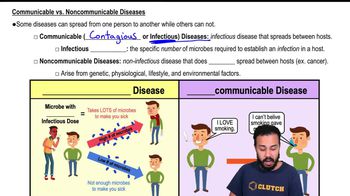
Which of the following phrases describes a contagious disease?
a. A disease arising from fomites
b. A disease that is easily passed from host to host in aerosols
c. A disease that arises from opportunistic members of the resident microbiome
d. Both a and b
A patient contracted athlete’s foot after long-term use of a medication. His physician explained that the malady was directly related to the medication. Such infections are termed:
a. Healthcare-associated infections
b. Exogenous infections
c. Iatrogenic infections
d. Endogenous infections
Endotoxin, also known as ___________, is part of the outer (wall) membrane of Gram-negative bacteria.