Ch. 1 - A Brief History of Microbiology
Bauman - Microbiology with Diseases by Taxonomy 6th Edition
Bauman6th EditionMicrobiology with Diseases by TaxonomyISBN: 9780134832302Not the one you use?Change textbook
Chapter 1, Problem 7

Van Leeuwenhoek described microorganisms as:
a. Animalcules
b. Prokaryotes
c. Eukaryotes
d. Protozoa

Verified step by step guidance
1
Recall the historical context: Antonie van Leeuwenhoek was one of the first scientists to observe microorganisms using a microscope he designed himself in the late 1600s.
Understand the terminology: Van Leeuwenhoek described the tiny living organisms he observed in water and other samples with a specific term that reflects their small, animal-like appearance.
Review the options: 'Animalcules' refers to tiny animals or animal-like organisms, 'Prokaryotes' and 'Eukaryotes' are modern classifications based on cell structure, and 'Protozoa' are a group of single-celled eukaryotes.
Identify that the term 'Animalcules' was historically used by Van Leeuwenhoek to describe microorganisms because he saw them as tiny animals moving around under the microscope.
Conclude that the correct answer is the term Van Leeuwenhoek used, which is 'Animalcules'.

Verified video answer for a similar problem:

This video solution was recommended by our tutors as helpful for the problem above.
Video duration:
1m
Was this helpful?

Key Concepts

Here are the essential concepts you must grasp in order to answer the question correctly.

Van Leeuwenhoek's Contribution to Microbiology

Antonie van Leeuwenhoek was the first to observe and describe microorganisms using a simple microscope he designed. He called these tiny living organisms 'animalcules,' meaning little animals, highlighting their movement and life-like behavior.
Recommended video:
Guided course
07:27
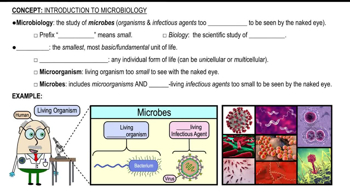
Introduction to Microbiology

Definition of Animalcules

'Animalcules' is an early term used to describe microscopic organisms, especially those that appeared animal-like under the microscope. This term predates modern classifications and reflects the initial understanding of microbes as tiny animals.
Recommended video:
Guided course
03:55
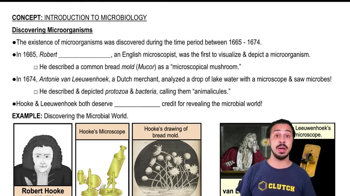
Discovering Microorganisms

Distinction Between Prokaryotes and Eukaryotes

Prokaryotes are microorganisms without a nucleus, like bacteria, while eukaryotes have a defined nucleus, including protozoa and fungi. Van Leeuwenhoek's term 'animalcules' was used before these classifications existed, so it does not correspond directly to either group.
Recommended video:
Guided course
05:54
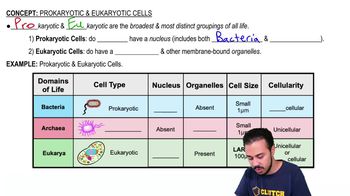
Prokaryotic & Eukaryotic Cells