Microbiology
My Course
Learn
Exam Prep
AI Tutor
Study Guides
Textbook Solutions
Flashcards
Explore
Try the app
My Course
Learn
Exam Prep
AI Tutor
Study Guides
Textbook Solutions
Flashcards
Explore
Try the app
Back
Urinary Tract Infections (UTIs) quiz
You can tap to flip the card.
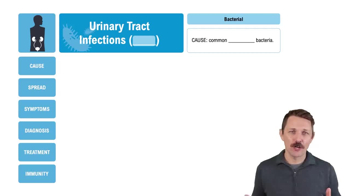
What is the most common bacterial cause of urinary tract infections (UTIs)?
You can tap to flip the card.
👆
What is the most common bacterial cause of urinary tract infections (UTIs)?
Escherichia coli (E. coli) is the most common cause, responsible for over 70% of UTI cases.
Track progress
Control buttons has been changed to "navigation" mode.
1/15
Related flashcards
Recommended videos
Urinary Tract Infections (UTIs) definitions
Urinary Tract Infections (UTIs)
15 Terms
03:11
Urinary Tract Infections (UTIs) Example 1
09:09
Urinary Tract Infections (UTIs)
Terms in this set (15)
Hide definitions
What is the most common bacterial cause of urinary tract infections (UTIs)?
Escherichia coli (E. coli) is the most common cause, responsible for over 70% of UTI cases.
Name two other bacteria, besides E. coli, that can cause UTIs.
Proteus and Klebsiella are two other bacteria that can cause UTIs.
What is the typical cause of fungal UTIs?
Fungal UTIs are usually caused by Candida albicans.
Why are UTIs more common in females than males?
Females have a shorter urethra and the urethra is closer to the anus, increasing the risk of bacterial entry.
What is the term for infection of the urethra?
Infection of the urethra is called urethritis.
What symptoms are commonly associated with lower UTIs?
Lower UTIs commonly cause dysuria (painful urination) and frequent urination.
What is cystitis?
Cystitis is an infection of the bladder.
What is pyelonephritis?
Pyelonephritis is a kidney infection, considered an upper UTI.
What symptoms are typical of upper UTIs like pyelonephritis?
Upper UTIs often cause high fever and flank or back pain.
What diagnostic test detects nitrites and leukocyte esterase in urine?
A dipstick test is used to detect nitrites and leukocyte esterase in urine.
What does the presence of nitrites in urine indicate?
Nitrites in urine indicate bacterial conversion of nitrates, suggesting a UTI.
What is the significance of leukocyte esterase in urine?
Leukocyte esterase indicates the presence of white blood cells, which suggests infection.
What is the threshold of colony-forming units (CFUs) per milliliter that typically indicates a UTI?
100,000 CFUs per milliliter is the common threshold for diagnosing a UTI.
Name two antibiotics commonly used to treat UTIs.
Nitrofurantoin and sulfa drugs (like trimethoprim-sulfamethoxazole) are commonly used.
Why is prevention important for UTIs?
No immunity develops after a UTI, and previous infections increase the risk of recurrence, making prevention essential.