Back

Types of Small Molecule Transport Review quiz

Control buttons has been changed to "navigation" mode.
1/15
  • What is simple diffusion and does it require energy?

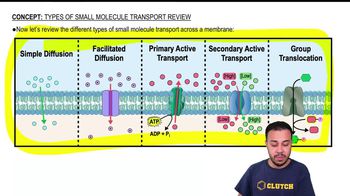
    Simple diffusion is a passive transport method that does not require energy, allowing small non-polar molecules to move from high to low concentration across the membrane.
  • Which types of molecules are most likely to cross the membrane via simple diffusion?

    Small, non-polar molecules are most likely to cross the membrane via simple diffusion.
  • What is facilitated diffusion and what does it require?

    Facilitated diffusion is a passive transport method that requires membrane proteins, such as channels, to help charged or large molecules cross the membrane.
  • Does facilitated diffusion require energy input?

    No, facilitated diffusion does not require energy input; it moves molecules from high to low concentration.
  • Why can't ions cross the membrane by simple diffusion?

    Ions cannot cross the membrane by simple diffusion because they are charged and need membrane proteins to facilitate their movement.
  • What is active transport and how does it differ from passive transport?

    Active transport requires energy to move molecules against their concentration gradient, from low to high concentration, unlike passive transport which does not require energy.
  • What is primary active transport and what energy source does it use?

    Primary active transport directly uses ATP to move molecules across the membrane against their concentration gradient.
  • How does secondary active transport differ from primary active transport?

    Secondary active transport does not directly use ATP; instead, it uses the energy from another molecule moving down its concentration gradient.
  • What powers the movement of molecules in secondary active transport?

    The movement is powered by the energy released as another molecule moves down its concentration gradient.
  • What is group translocation and in which organisms is it mainly found?

    Group translocation is a transport method mainly found in bacteria, where the entering molecule is chemically modified during transport.
  • What is an example of group translocation in bacteria?

    An example is glucose being chemically modified to glucose 6-phosphate as it enters E. coli bacteria.
  • Does group translocation require energy, and if so, how is it used?

    Yes, group translocation requires a high-energy molecule to chemically modify the entering molecule.
  • How are simple diffusion and facilitated diffusion similar?

    Both are passive transport methods that move molecules from high to low concentration without using energy.
  • What role do membrane proteins play in facilitated diffusion?

    Membrane proteins, such as channels, help facilitate the movement of charged or large molecules across the membrane.
  • Why is group translocation sometimes considered a type of active transport?

    Because it requires energy to chemically modify the molecule as it enters the cell, group translocation is sometimes grouped as an alternative type of active transport.