Back

Types of Small Molecule Transport Review definitions

Control buttons has been changed to "navigation" mode.
1/13
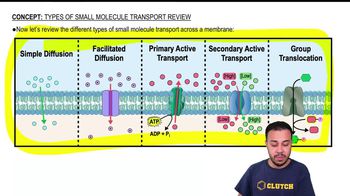
  • Simple Diffusion

    Passive movement of small non-polar molecules directly through the membrane, requiring no energy or protein facilitator.
  • Passive Transport

    Movement of molecules across a membrane without energy input, always following the concentration gradient.
  • Facilitated Diffusion

    Passive transport of ions or polar molecules across a membrane via specific proteins like channels.
  • Membrane Protein

    Integral or peripheral molecule embedded in the membrane, enabling or assisting the passage of specific substances.
  • Channel

    Protein structure forming a pore in the membrane, allowing selective passage of ions or molecules.
  • Active Transport

    Energy-dependent process moving molecules against their concentration gradient, from low to high concentration.
  • Primary Active Transport

    Direct use of ATP to move molecules across a membrane against their concentration gradient.
  • Secondary Active Transport

    Indirect use of ATP, utilizing the energy from another molecule's gradient to drive transport.
  • Concentration Gradient

    Difference in the amount of a substance across a membrane, driving passive or active movement.
  • ATP

    High-energy molecule directly powering primary active transport processes in cells.
  • Group Translocation

    Bacterial transport method where the entering molecule is chemically modified during passage into the cell.
  • Phospholipid

    Major membrane component forming a bilayer, allowing selective permeability to small non-polar molecules.
  • Ion

    Charged particle requiring protein facilitation to cross the hydrophobic membrane interior.