Back

Types of Membrane Proteins quiz

Control buttons has been changed to "navigation" mode.
1/15
  • What are the two main types of membrane-associated proteins?

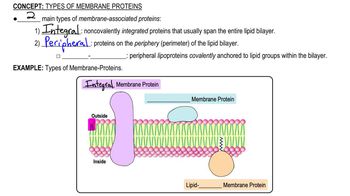
    The two main types are integral and peripheral membrane-associated proteins.
  • How do integral membrane proteins interact with the lipid bilayer?

    Integral membrane proteins span the entire lipid bilayer, having both extracellular and intracellular portions.
  • Where are peripheral membrane proteins located relative to the lipid bilayer?

    Peripheral membrane proteins are found on the perimeter of the lipid bilayer and do not span it.
  • What distinguishes lipid-linked membrane-associated proteins from other peripheral proteins?

    Lipid-linked membrane-associated proteins are covalently anchored to lipid groups within the bilayer, making them lipoproteins.
  • What is the main structural difference between integral and peripheral membrane proteins?

    Integral proteins span the bilayer, while peripheral proteins are only attached to its surface.
  • What mnemonic can help remember the general functions of membrane proteins?

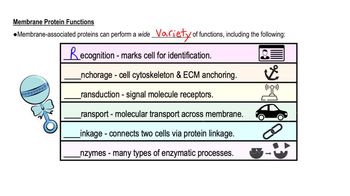
    The mnemonic 'RATTLE' stands for Recognition, Anchorage, Transduction, Transport, Linkage, and Enzyme.
  • What is the function of membrane proteins involved in recognition?

    Recognition proteins help immune cells distinguish between healthy and foreign cells.
  • How do membrane proteins contribute to anchorage?

    Anchorage proteins attach the cell's cytoskeleton to the extracellular matrix.
  • What role do membrane proteins play in signal transduction?

    They receive and transmit signals across the cell membrane, facilitating communication.
  • How do membrane proteins facilitate molecular transport?

    Transport proteins allow molecules to move across the membrane, either into or out of the cell.
  • What is the linkage function of membrane proteins?

    Linkage proteins connect cells together, similar to linking paper clips.
  • What enzymatic function do membrane proteins perform?

    Membrane proteins can act as enzymes, speeding up chemical reactions within the cell.
  • What is a lipoprotein in the context of membrane proteins?

    A lipoprotein is a protein covalently linked to a lipid group, often found as a lipid-linked peripheral membrane protein.
  • Do peripheral membrane proteins span the lipid bilayer?

    No, peripheral membrane proteins do not span the lipid bilayer; they are attached to its surface.
  • What is the significance of the extracellular and intracellular portions of integral membrane proteins?

    These portions allow integral proteins to interact with both the inside and outside of the cell, enabling diverse functions.